



-2.png)
-2.png)

.png)

.webp)
.png)



.png)



-1.webp)
-1.webp)

.webp)
-1-1.webp)


-2.webp)
-1-1.webp)

-2-1.png)
-1-1.webp)
-1-1.webp)
-1-1.png)





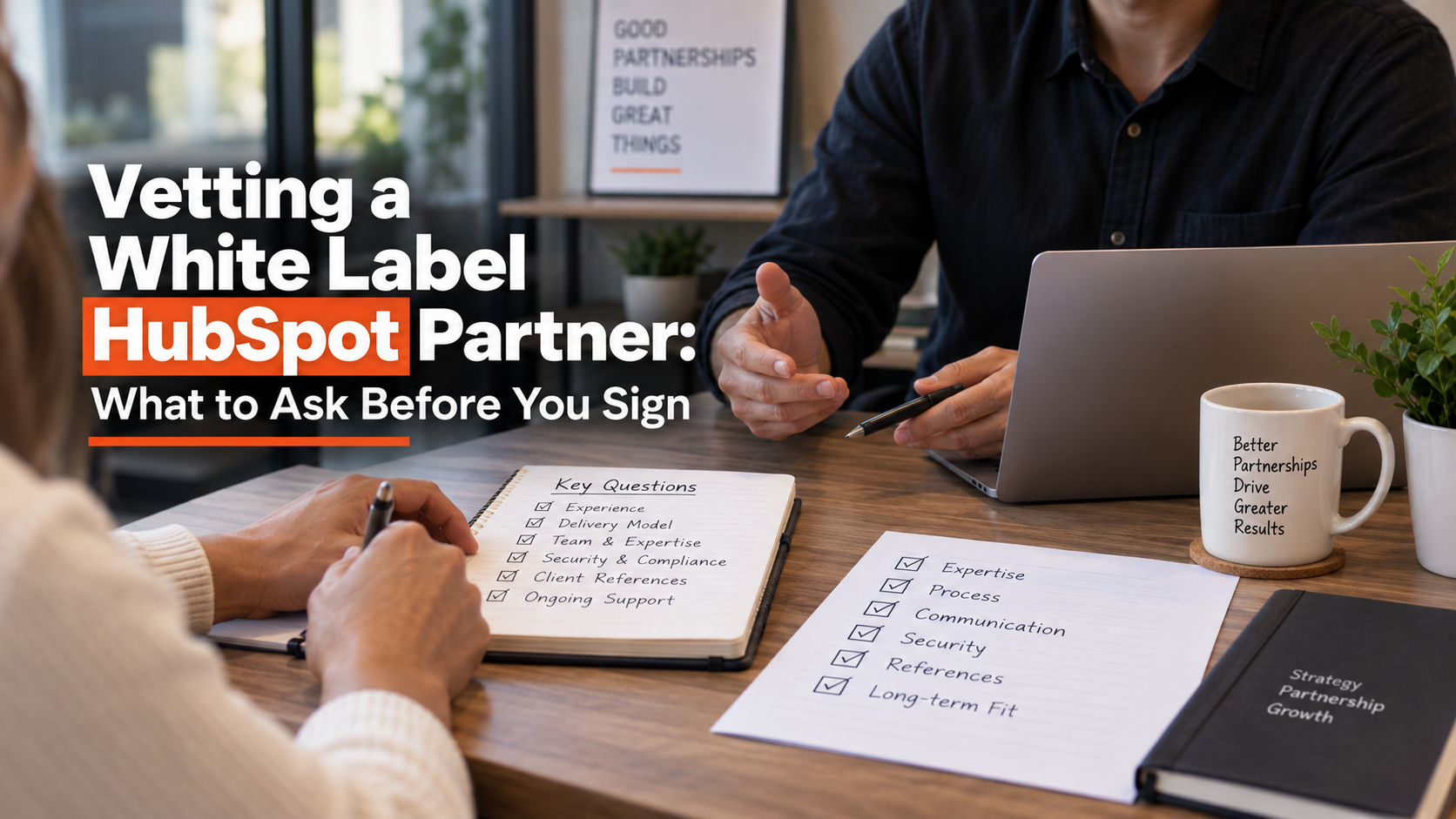
Most agencies vet a white-label HubSpot partner the same way they vet a vendor. They check the portfolio, compare pricing, and ask about certifications.
None of that protects you from the two failures that actually happen: the team you interviewed is not the team that does the work, and the arrangement itself is not structured the way your contract implies.
Fixing either problem after signing costs far more than asking the right question before you do. This post covers the questions that catch both, starting with one most agencies never think to ask.
Start With the Disclosure HubSpot Itself Requires

Before you negotiate confidentiality terms with a white-label vendor, check whether you owe HubSpot a disclosure of your own. HubSpot's Partner Program Agreement requires partners to notify HubSpot in advance if they plan to use a third-party subcontractor, consultant, or agent to help deliver contracted services (Source: HubSpot Partner Program Agreement).
This sits separate from any NDA you sign with the delivery firm for your client's benefit. Skipping it is a program compliance issue, not just a business risk.
Ask your prospective partner directly whether they expect you to file that disclosure, and whether they have handled it with other agencies before. A partner who has never heard the question is not necessarily dishonest, but they are inexperienced with the compliance side of white-labeling, which tells you something about how carefully they run the rest of the arrangement too.
Verify Certifications & Tier the Way HubSpot Verifies Reviews

Certifications and tier badges are easy to display and hard to independently confirm from a website alone. HubSpot's own partner directory reviews are tied to verified client engagements and cannot be selectively published or fabricated the way testimonials on an agency's own site can (Source: How to Choose a HubSpot Partner).
Ask for the partner's directory listing directly rather than relying on the tier badge shown in their sales deck.
Tier and certifications tell you about scale and baseline competence. They do not tell you whether the specific people doing your work hold those certifications personally, or whether the badge belongs to a founder who no longer touches client portals.
Ask which named individuals will work on your account and what they are certified in, not just what the company as a whole holds.
Ask Exactly Who Touches the Portal

Get specific about the access model before you sign. Will the delivery partner work as a named user inside your existing portal, or will they maintain a separate sandbox and hand off finished work?
Each model carries different data exposure, and the answer also determines who HubSpot associates with the account for retention and tier purposes, the same mechanic covered when we looked at whether white-labeled work counts toward your own partner tier.
Ask how credentials are handled during the engagement and how access is revoked afterward. A partner using a shared password manager with individual logins and a documented offboarding step is a different risk profile than one that passes around a single shared login with no clear deprovisioning process.
Get the Onward-Subcontracting Question Answered in Writing

The most common failure mode across the white-label agencies reviewed for this post is quiet onward subcontracting: the firm you vetted hires a third tier to actually perform the work. This is the fastest way for the team you evaluated to stop being the team you receive.
Ask directly whether the partner subcontracts any portion of delivery, and get the answer written into the agreement rather than left as a verbal assurance from the sales call.
If subcontracting is disclosed only after the proposal is signed, treat that as a red flag on its own, regardless of how the finished work turns out.
Pin Down the Contract Structure Before You Pin Down the Price
Most white-label arrangements run on a two-contract structure: the delivery partner contracts with your agency, never directly with your client. Confirm that structure explicitly, and confirm what happens in the rare case a client's own master agreement requires every party touching the code or portal to be named on paper.
A partner with a clear, pre-written answer to that exception has handled it before. One who improvises on the spot has not.
Also confirm when intellectual property and work product formally transfer to you. A transfer triggered by final settlement is not the same as transfer on delivery, and if your own client agreement promises ownership on delivery, a mismatched transfer clause leaves you promising something you do not yet legally hold.
Run a Small Pilot Before the Flagship Project
Test the relationship on a bounded project before committing your highest-stakes engagement. Watch how quickly the partner acknowledges a brief. Response speed during a low-stakes pilot is close to the best-case version of what you will see once real deadlines and client pressure are involved, not the floor.
A pilot that runs perfectly with zero friction proves less than one that surfaces a disagreement, since how a partner handles pushback tells you more than how they handle an easy assignment.
Red Flags That Should End the Conversation
-
Reluctance to introduce the actual delivery team before the contract is signed
-
Generic capacity answers that reference "our team" with no names or roles
-
Subcontracting disclosed after the proposal instead of during the sales conversation
-
A non-solicit clause that protects only the delivery partner, not your agency
-
Slower than 48-hour acknowledgment of a brief during the pilot phase
-
No clear answer on credential handling or access deprovisioning after the engagement ends
FAQs
Who will actually do our work, and what are their certifications?
Ask for the specific consultants or developers assigned to your projects, including their HubSpot certifications, years of experience, and relevant case studies. Avoid partners who cannot name the team or hide behind a generic “resource pool,” as this often signals high turnover or undisclosed subcontracting.
What is your end-to-end delivery and QA process for white label projects?
Look for a documented workflow covering discovery, scoping, build, QA, launch, and handoff, plus a written QA checklist for forms, workflows, permissions, and tracking. Partners without clear processes create scope creep, missed deadlines, and inconsistent quality that lands on your desk.
Will you sign our NDA and white label agreement without major changes?
A credible partner should accept standard NDAs and white label terms that protect your client relationships, IP, and brand boundaries. Heavy negotiation or refusal is a red flag for future leaks, direct client contact, or IP disputes.
What pricing model do you use, and what counts as extra?
Clarify whether they charge per project, per hour, or via retainers, and get written definitions of what is included versus what triggers change orders or additional fees. Vague pricing and undefined “extras” are the fastest way to erode your margin and surprise clients.
Can we start with a paid pilot before committing long-term?
A confident partner will welcome a small, well-scoped pilot with clear success criteria instead of pushing for large, locked-in contracts upfront. Treat the pilot as a test of delivery, communication, and fit, not just technical capability.
Founder & CEO @ Hubxpert. My goal is to make every company using HubSpot succeed in their marketing organisation and automation.

Ratul Rahman
Table of Contents:

Subscribe to our newsletter

Modern Website Design Examples & What Makes Them Work
Browse modern website design examples and modern looking websites, and see exactly what separates a fast, current site from one that already feels dated.

Interactive Web Design Templates & Examples to Study
See interactive web design templates and the best interactive web design inspiration, then compare interactive web page design examples before you build.

Interactive Elements in Web Design & Where to Stop
Add interactive elements in web design that earn their place, covering micro interactions, interactive maps, interactive timelines and knowing when to stop.

3D Web Design Templates & Examples You Can Reuse
Browse 3D web design templates and examples, plus where to find free downloads, and see how 3D web page design lifts a site without slowing the site down.

3D Web Design Tools & Software Compared for 2026
Compare 3D web design tools and web based 3D design software, and see where 3D models and 3D assets for web design fit your existing front-end build pipeline.

HubSpot Onboarding Cost: What the Fee Really Covers
See what HubSpot onboarding cost covers, how onboarding fees get quoted and how to compare implementation quotes line by line before you commit to a partner.
-
Modern Website Design Examples & What Makes Them Work
hello
-
Interactive Web Design Templates & Examples to Study
hello
-
Interactive Elements in Web Design & Where to Stop
hello
-
3D Web Design Templates & Examples You Can Reuse
hello
-
3D Web Design Tools & Software Compared for 2026
hello
-
HubSpot Onboarding Cost: What the Fee Really Covers
hello