


-2.png)

-2.png)

.png)


.webp)

.png)





.png)




-1.webp)
-1.webp)

.webp)

-1-1.webp)



-2.webp)
-1-1.webp)

-2-1.png)
-1-1.webp)
-1-1.webp)
-1-1.png)







Discovery
Mapped lead sources, patient types, and the real front desk workflow, including the workarounds.


500%
Lead generation increased
142%
Patient follow up improvements
10%
Increased revenue monthly
Leva Medical's marketing was working. The practice was generating hundreds of inquiries a month across television, Google, and social campaigns, and the front desk was the only thing standing between more inquiries and a booked consultation. There was no shared record of who had called, what they wanted, or what had happened since. The result was a growing volume of demand landing on a process built for a much smaller practice.
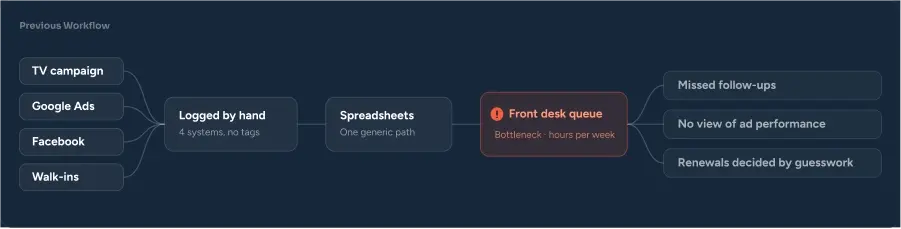
When a caller did not book on the spot, someone wrote the number down. Over time the notes accumulated across desks until, as Dr. Leva puts it, they were living in chaos with Post-it notes. Nothing about that record could be sorted, searched, assigned, or reported on.
Email ran through one platform, calls through the phone system, campaign data sat with the ad platforms, and patient information sat elsewhere. Each system held a fragment of the same person, and no system held the whole.
The team moved tracking into Excel to regain control. It added hours of manual entry, introduced errors, and still left everyone working from a file that was out of date the moment it was updated.
A patient inquiring about a major procedure, a membership patient due for a follow-up, and a first-time inquiry from a television ad all entered the same undifferentiated queue. Nothing in the process reflected how differently those conversations need to be handled.
With hundreds of leads open at once and time for only a fraction of them, the order of the call list was effectively arbitrary. High-intent patients waited behind cold ones, and the cost of that was not visible to anyone until it showed up as a slow month.
Spend on television, Google, and social kept rising, but no report connected a channel to a booked consultation and then to revenue. Budget decisions came down to instinct, which in a market this competitive is an expensive way to decide anything.
The people at the front desk were the ones absorbing the missed follow-ups and the duplicate work. Dr. Leva is direct about what that did to the team: everyone felt overwhelmed, and frustration ran in both directions between the practice and its patients.
"Before HubSpot, we were living kind of in chaos with Post-it notes. Every lead, every patient type, and every renewal had to be tracked manually, and our front desk was spending more time managing spreadsheets than focusing on patients."

HubXpert onboarded Leva Medical onto HubSpot as the operating system for sales and marketing, and built the practice's patient lifecycle inside it. The approach was deliberate: map the whole journey end to end before configuring anything, then build in stages so the front desk was never handed a system it had not seen. Dr. Leva, a surgeon, recognized the principle immediately. Look twice, cut once.
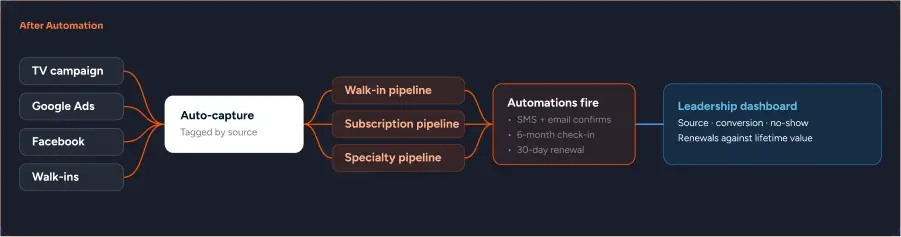
Television, Google, and social inquiries now arrive in HubSpot tagged with where they came from, at the moment they arrive. The phone system was connected so calls are captured against the same record rather than living in a separate log. There is one place to look, and it is complete.
Rather than one queue for everything, we mapped the stages a patient really moves through, from first contact to consultation to procedure to aftercare, and built dedicated pipelines around them. Every stage was designed before it was built, so the pipeline reflects the practice rather than a default template.
Contacts progress automatically as they act, so leadership can see the shape of the funnel at any moment: how many inquiries are genuinely new, how many are in consultation, and how many have moved into ongoing care. That progression is what makes every downstream report trustworthy.
We started with a hypothesis about what a warm lead looks like, then tested it. Recency of contact, length of the phone conversation, repeat visits, form submissions, and text message engagement each carry points. The highest scores rise to the top of the call list. Something that was impossible to calculate on a Post-it note now arrives on the front desk screen ranked. In Dr. Leva's words, the team was no longer working blind.
Nurture sequences keep inquiries warm between the first call and the consultation, and follow-up continues after a procedure rather than stopping at it. The design goal was stated by the client and adopted as the brief: take as much work off the staff as possible, because people make mistakes and the front desk should be talking to patients.
Aftercare, membership, and follow-on treatment are not separate campaigns bolted on afterward. They are stages in the same lifecycle, triggered by where a patient already is, so the practice grows the value of a relationship it has already earned rather than paying again to acquire a new one.
Leadership dashboards now connect a lead to its source, its pipeline stage, and its outcome, so spend on television, Google, and social can be judged against consultations booked and revenue produced. The practice tests, reads the result, and adjusts. Decisions are now made against data instead of instinct.
Our front desk team used to spend hours each week manually logging leads and chasing renewal calls. With HubSpot handling confirmations, reminders, and renewal nudges automatically, that time now goes straight into patient care. The dashboards also mean we stop guessing which campaigns are actually working.

Roughly a year after the engagement began, Leva Medical runs its patient lifecycle inside one system. Leads arrive attributed, patients move through defined stages, follow-up runs without anyone remembering to send it, and leadership can see which campaigns produce patients rather than clicks. The practice is still building, but the numbers from the first two quarters are already clear.
300%
Lead generation increased
164%
Patient follow up improvements
10%
Increased revenue monthly
Patient follow-up improved 142% in the first quarter and 164% in the second. The change came from removing the two things that broke follow-up: manual logging and an unranked call list.
Lead generation increased by 300% to 500%. The same channels now produce far more captured, workable leads, because inquiries that used to fall through the gaps between tools are held in one record.
Revenue increased 10% month over month. Faster response on higher-intent leads, plus aftercare and membership handled as part of the lifecycle rather than as an afterthought.
The front desk stopped guessing. Where the team once faced hundreds of open leads with no way to prioritize, the call list now arrives ranked by score. Time goes to the patients most likely to book.
Marketing spend became a decision instead of a bet. Every lead carries its source through to outcome, so television, Google, and social are judged on consultations and revenue rather than volume.
The work continues. Membership programs are expanding, more automation is being added, and the practice is testing new plays against real data. As Dr. Leva describes the arrangement, he sends an idea overnight from New York and it is usually built by the time he wakes up.
"They were no longer blind. With lead scoring, the front desk could identify which leads were likely to convert and prioritize follow-ups. The team could focus on the right patients at the right time."
We build the systems underneath growth. CRM, website, search, outbound, and automation, connected so your team stops doing the work software should do.
 Takes 30 minutes
Delivered by certified HubSpot expert
Takes 30 minutes
Delivered by certified HubSpot expert