



-2.png)
-2.png)

.png)

.webp)
.png)



.png)




-1.webp)
-1.webp)

.webp)
-1-1.webp)


-2.webp)
-1-1.webp)
-2-1.png)
-1-1.webp)
-1-1.webp)
-1-1.png)





A small healthcare practice can run smoothly with HubSpot. But add multiple locations, complex referral networks, and clinical coordination, and the CRM decision gets much harder.
The question is not simply whether you are a large or small healthcare organization. It comes down to how complex your workflows are, what data needs to stay connected, and where HubSpot’s flexibility is enough or falls short.
This guide breaks down the practical factors that can help you decide between a healthcare-specific CRM and HubSpot.
What HubSpot Is Actually Built to Do in Healthcare
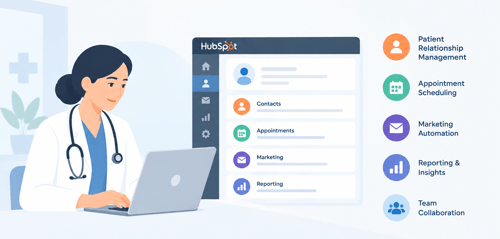
HubSpot tracks inquiries, moves them through a pipeline, and automates follow-up. It is built for growth and business development, not clinical care delivery. It fits practices where marketing and sales operations matter as much as, or more than, deep clinical workflow needs.
That includes elective and cosmetic practices, mental health and wellness groups, telehealth companies, vision care, and healthcare technology vendors. That fit is real, but it is also a boundary. A practice running primarily on complex clinical coordination is asking HubSpot to do a job it was not built for.
Where Healthcare-Specific CRMs Win
A handful of things come built in on a vertical platform that HubSpot simply does not offer. Salesforce Health Cloud connects natively to Epic and Cerner through HL7 and FHIR standards. HubSpot has no equivalent. Solutionreach and similar platforms include insurance eligibility checks tailored to dental and vision practices. ReferralMD and Trella Health are built specifically for closed-loop referral tracking across a care network.
They operate at a scale association labels inside a general CRM were never meant to handle. Patient intake forms are a core feature on these platforms, not something bolted on afterward. KLAS Research's 2025 Best in KLAS ranking placed Innovaccer and Epic Cheers above Salesforce CRM specifically on healthcare value (Source: "Best in KLAS: Customer Relationship Management (CRM) 2025"). HubSpot is not evaluated in that ranking at all, since KLAS scores enterprise health-system CRM, a different buyer than most of this cluster's audience.
Where HubSpot Wins
The trade runs both ways. HubSpot's marketing automation is more sophisticated than what most narrow healthcare CRMs offer. Its pipelines are flexible and not tied to a fixed clinical data model. Its app marketplace covers far more integrations than a point healthcare tool ever will.
For a smaller practice, HubSpot is usually faster to set up and cheaper to run than an enterprise platform like Salesforce Health Cloud.
That gap narrows once PHI enters the picture. PHI handling requires HubSpot's Enterprise tier specifically, a distinction covered in full in a HIPAA compliance breakdown.
A Real Case of Outgrowing HubSpot
A company selling into hospitals and clinics ran into a structural wall. It happened on HubSpot's own Community forum (Source: "HubSpot for Selling to Hospitals and Clinics"). HubSpot deduplicates company records by domain. Many independent clinics inside one hospital system share a single parent domain. The poster could not import their target list.
The domain, HubSpot's unique identifier, treated dozens of distinct clinics as one record. By the following year, the same company had made its decision. In their words: "We're moving to Salesforce for everything other than marketing." This is not a hypothetical limitation. It is a documented, dated account of exactly where the ceiling sits.
The Real Threshold Test
|
Question |
HubSpot Is Likely Enough |
Look at a Vertical CRM |
|
How many independent clinics share one parent organization? |
One location, or a handful under one domain |
Many clinics sharing one hospital-system domain |
|
Does PHI need to appear in reporting or analytics, not just CRM records? |
No, PHI stays in standard CRM properties |
Yes, PHI-driven reporting is core to the workflow |
|
How large and structured is the referral network? |
A few dozen referring providers |
Hundreds of sources needing tiered tracking |
|
Does the system need to touch clinical data directly, not just engagement data? |
No, clinical data stays in the EHR |
Yes, native EHR connectivity is required |
Answering "look at a vertical CRM" on two or more of these questions is a real signal. One answer alone usually is not.
A Pricing Reality Check
HubSpot's PHI and BAA support requires Enterprise tier, with onboarding fees typically running $1,500 to $7,000 per hub. Salesforce Health Cloud runs roughly $325 to $750 per user per month, well above HubSpot at most tiers.
But healthcare-specific does not automatically mean more expensive. ReferralMD offers a free tier with usage-based add-ons. Tebra's bundled suite starts around $49 per provider per month.
The real comparison is not HubSpot versus healthcare-specific software as categories. It is HubSpot versus the specific platform that matches a practice's actual workflow.
Correcting a Common Myth: HIPAA BAAs Are Not Salesforce-Exclusive
At least one widely shared comparison article claims a Business Associate Agreement is only available through Salesforce, not HubSpot. That claim is false. HubSpot has offered a BAA on Enterprise tier since October 2024, and the agreement remains generally available today. The full mechanics are covered in a detailed breakdown of what HubSpot's BAA actually covers.
That includes which specific tools and workflow actions stay excluded even under a signed BAA. A stale or incorrect claim like this is worth checking against a dated primary source before it shapes a real decision.
Frequently Asked Questions
What is a healthcare-specific CRM?
A CRM built around clinical workflows rather than general marketing and sales operations. Examples include native EHR connectivity, referral network analytics at scale, and insurance eligibility checks.
Can HubSpot handle HIPAA-compliant patient data?
Yes, on Enterprise tier with a signed Business Associate Agreement. Several specific tools and workflow actions stay excluded regardless of tier.
When does a practice outgrow HubSpot?
Typically once several independent clinics share one parent domain. Other signals include a referral network reaching hundreds of sources, or PHI needing to appear directly in reporting and analytics rather than standard CRM records.
Is HubSpot cheaper than Salesforce Health Cloud?
Usually, at most tiers. Salesforce Health Cloud runs roughly $325 to $750 per user per month. HubSpot's Enterprise tier is generally lower, though onboarding fees still apply.
Which healthcare businesses is HubSpot best suited for?
Elective and cosmetic practices, mental health and wellness groups, telehealth companies, vision care, and healthcare technology or medical device vendors. These are HubSpot's documented healthcare use cases, where marketing and sales operations carry as much weight as clinical workflow.
Senior RevOps Strategist at Hubxpert

Fazle Rabbi
Table of Contents:

Subscribe to our newsletter

3D Web Design Templates & Examples You Can Reuse
Browse 3D web design templates and examples, plus where to find free downloads, and see how 3D web page design lifts a site without slowing the site down.

3D Web Design Tools & Software Compared for 2026
Compare 3D web design tools and web based 3D design software, and see where 3D models and 3D assets for web design fit your existing front-end build pipeline.

HubSpot Onboarding Cost: What the Fee Really Covers
See what HubSpot onboarding cost covers, how onboarding fees get quoted and how to compare implementation quotes line by line before you commit to a partner.

HubSpot Enterprise Onboarding (What Changes by Tier)
See how HubSpot enterprise onboarding differs from Professional and Starter, covering advanced onboarding scope, admin training and what each tier includes.

Best HubSpot CRM Implementation Consulting Agencies for B2B
Compare 6 HubSpot partners for B2B with pros, cons, and pricing. Learn how to judge companies offering HubSpot implementation services and spot red flags.

How to Build a HubSpot Implementation Plan That Holds Up
Follow a HubSpot implementation plan covering scoping, data cleanup and go-live. Includes an implementation checklist and a realistic 60-day timeline.
-
3D Web Design Templates & Examples You Can Reuse
hello
-
3D Web Design Tools & Software Compared for 2026
hello
-
HubSpot Onboarding Cost: What the Fee Really Covers
hello
-
HubSpot Enterprise Onboarding (What Changes by Tier)
hello
-
Best HubSpot CRM Implementation Consulting Agencies for B2B
hello
-
How to Build a HubSpot Implementation Plan That Holds Up
hello