























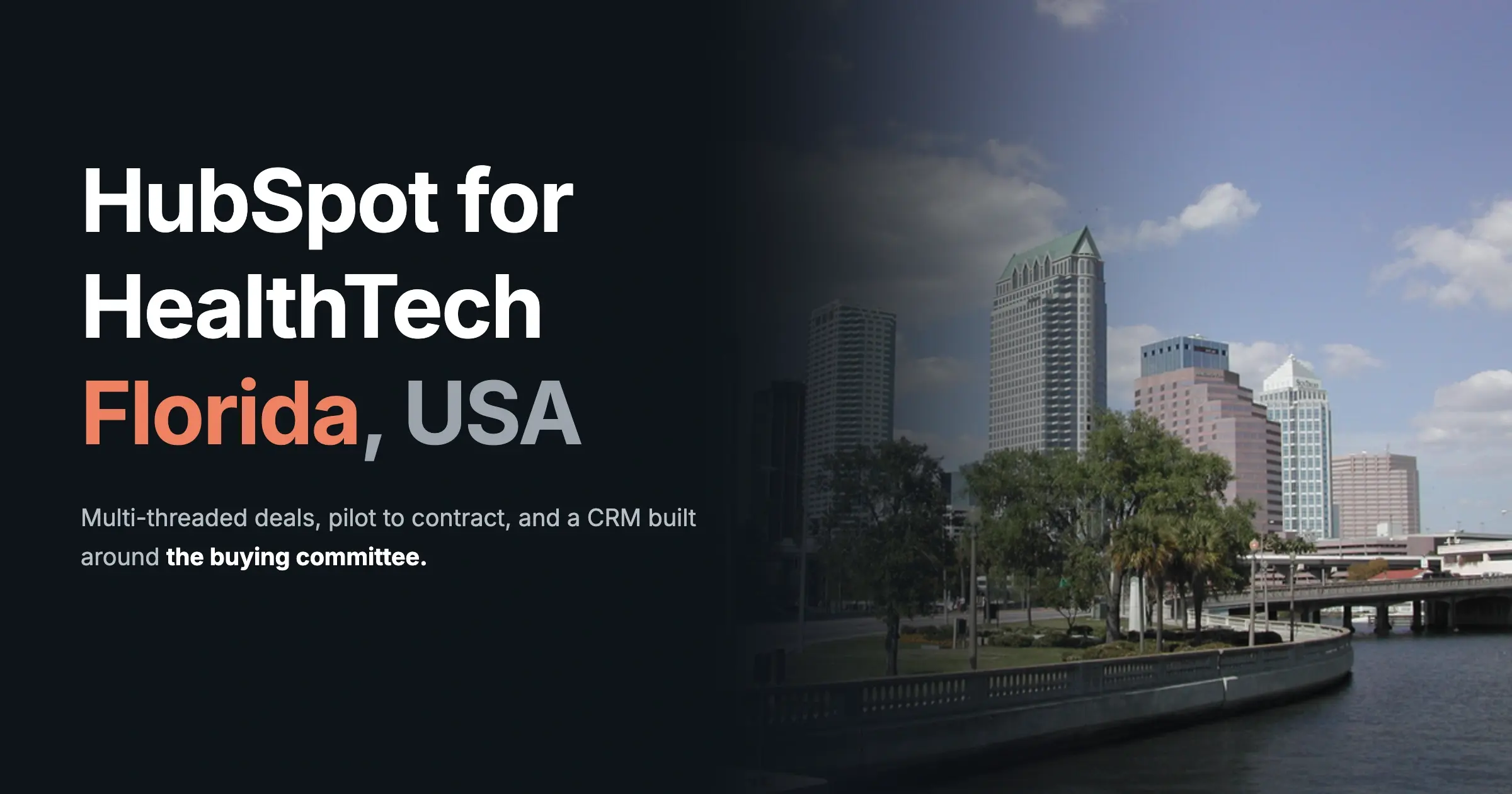
HubSpot for HealthTech Florida, USA
Meta title: HubSpot for HealthTech Florida | Hospital Deal CRM Setup
Meta description: How Florida healthtech companies use HubSpot to run hospital committees, pilots and HIPAA reviews, what a build includes and what it costs, plus a timeline.
URL slug: /blog/hubspot-for-healthtech-florida
---
Florida healthtech teams sell into hospitals, clinics and payers, where one deal can carry six decision makers and run past two budget cycles. The mess is rarely the product: the committee nobody mapped, the pilot counted as a sale, and the champion who left in March. HubXpert builds HubSpot around that pattern, with a company record per hospital, buying roles on each contact and a deal that keeps its history.
Key takeaways
- A hospital deal runs through five or six people, so the account and the committee matter more than any single contact.
- Company records with parent and child accounts keep a health system and its individual hospitals readable.
- Pilots need their own stages, or your forecast counts a trial as a sale.
- HubSpot can hold a signed business associate agreement on eligible plans, but it is not a place to store patient records.
- Ask for the property list and the workflow count in writing before you sign.
What a Florida healthtech company is actually selling
Take a remote patient monitoring platform with a Tampa office and forty hospital clients. The product is software, devices and a change to clinical workflow, and nobody buys that in a week.
The champion is often a director of nursing informatics or a population health lead. She likes the product but cannot sign a contract, approve a security review or release budget on her own.
Three other people appear before the deal closes, and hospital IT asks where the data lives. Compliance asks about the business associate agreement. Procurement asks for a SOC 2 report and a redlined contract. Software that reads clinical data and claims a diagnostic use also falls under FDA device rules.
Deals of this shape often run six to nine months. Some stall for a year, then restart when a new champion arrives with fresh budget. A funnel with one contact and one stage cannot describe that. This is why HubSpot for healthtech Florida teams has to be designed around accounts, not around leads.
Why a contact-based CRM breaks a hospital deal
Most CRMs are built around a contact: one person, one record, one owner, one stage. That model works for a $200 subscription sale but falls apart when a health system has twelve hospitals, each with its own IT group. Reimbursement runs through CMS coding rules, which decide whether the hospital has budget this year.
Four problems show up in the first month. Sales Hub is priced per seat and HubSpot publishes tiers at Sales Hub pricing.
- The committee is invisible. Six people influence the deal and the CRM tracks one.
- The account is fragmented. "Bay Area Health" and "Bay Area Health, North Campus" exist as two companies that never speak to each other.
- The champion leaves. Her successor inherits nothing, because the relationship lived in a mailbox.
- A pilot looks closed. The forecast counts a free trial as pipeline, and the number is wrong by quarter end.
None of those are HubSpot failures, just design failures that cost real revenue.
How HubSpot for HealthTech Florida models the buying committee
The company record becomes the account. There is one company per hospital, and a parent company above the system when a group owns several sites. HubSpot parent and child associations let you report on the system without losing the site level detail.
Then the people. Each contact gets a buying role property, such as champion, economic buyer, clinical reviewer or technical evaluator, and those values drive routing.
Association labels do the rest, so a contact is labeled champion on the deal, not in a note nobody reads. When she changes jobs, you filter by that label and see every open deal that just lost its champion.
Two more fields earn their place. A committee map shows which roles are covered, while a last touch date shows which deals rest on one thread.
Pipelines that carry a pilot to a contract
A healthtech pipeline should not end at signature. It should start long before a pilot and keep going after one.
A workable stage set: discovery, solution review, security review, pilot scoping, pilot live, pilot results, contract review, legal, signed, handover.
Two details matter more than the stage names.
First, keep pilots in their own pipeline when the volume is high. A free pilot is not revenue, and mixing it into the main forecast teaches the sales team to distrust the number.
Second, record the pilot start date, the pilot end date and the success criteria as deal properties. Without them, you cannot answer the only question the board asks: how many pilots turn into contracts, and how long does that take?
Device-led sales add a distributor tier on top of the committee, set out in the HubSpot for MedTech Florida guide.
Custom objects for integrations and implementations
Two custom objects remove most of the mess after signature.
An integration object holds the technical connection. One record per hospital: EHR vendor, interface engine, data feeds, security contact, go live date. A hospital with three sites and two EHRs gets six records, not a paragraph in a deal note.
An implementation object tracks the delivery work. Kickoff, device shipping, staff training, clinical validation, go live. Each record links to the deal and the company.
That split keeps delivery out of the sales pipeline, so a signed deal does not sit for months waiting on training. The sales report stops lying about cycle time.
Custom objects require an Enterprise tier, so plan for that in the subscription budget, not after the build starts.
Where HubSpot stops on HIPAA
HubSpot can act as a business associate and will sign a business associate agreement on eligible plans. That covers the sales and marketing data inside the portal, but it does not turn HubSpot into a clinical system.
Three limits to plan around.
Patient data stays out. No medical record numbers, no diagnoses, no device readings, no images. If a field could identify a patient and a condition, it does not belong in a contact property.
Forms should not collect clinical detail, so a demo request asking what condition a patient population has is a risk.
Email is not a care channel. Nurture sequences belong to buyers, not patients, and a patient outreach program belongs in a clinical platform.
A good build makes those limits visible. Field level permissions, blocked properties on forms, and a written rule sheet for the sales team. Ask your partner to show where patient data is blocked, not just where a signed agreement is filed.
What a build costs and how long it takes
Sales Hub implementation starts at $2,500 and runs three to six weeks. A healthtech build lands at the top of that range or beyond it, because the account model and committee design add work.
A HubSpot for healthtech Florida build of that size covers one product line, two pipelines, six buying roles, three custom objects and twelve workflows.
The subscription depends on hub mix and seat count. Custom objects and sandboxes both sit above Professional.
The expensive part is rarely the software. It is the data cleanup, the migration from spreadsheets, and training for a sales team that has never logged a call.
Teams comparing agencies can read how the best HubSpot agencies in Florida for healthtech are ranked and what each one covers.
Why HubXpert builds these
A hospital deal is a committee, not a contact, and the portal either reflects that or quietly loses the deal to whoever tracked it better. HubXpert starts with the account model for that reason: the parent system, the site, the department and the people in each buying role.
Then come the pilot stages, the security review and the implementation record that keeps a signed account from falling into a spreadsheet after go live. The property list is agreed in writing, and the same team scopes, builds and migrates.
HubXpert is a HubSpot Platinum Partner with a US office in St Albans, Vermont and a UK office in London, holding onboarding, custom integration and data migration accreditation at once.
Pros
- Triple HubSpot accredited: onboarding, integration and migration
- Account models built for committees, with parent and child companies
- All-in-one: HubSpot, websites, UI/UX, AI agents and cold email
- Named advisors in the US and Europe: Galen Dow and Oliver Lopez
- $2.9M in pipeline in 12 months, 45+ businesses grown, 150+ projects
- Written data model at handover, so the portal survives staff changes
Cons
- Platinum, not Elite yet, with Elite as the stated target
- No public price list, so scope has to be discussed before a number appears
FAQs
Can HubSpot track a hospital buying committee?
Yes. Use one company per hospital, with parent and child associations for the system. Add a buying role property on each contact, plus labels for champion and economic buyer.
Do we need Enterprise for custom objects?
Yes. Custom objects sit in Enterprise tiers, and so do sandboxes. Most healthtech builds need both, so budget for Enterprise before the project starts.
Is HubSpot HIPAA compliant?
HubSpot offers a business associate agreement on eligible plans, which covers the sales and marketing data it holds. It is not designed to store patient records, and no partner should tell you otherwise.
How long does a healthtech setup take?
Three to six weeks for a single product line with two pipelines. Six to ten when a team sells to providers and payers, needs custom objects, and migrates from spreadsheets.
Can we report on pilot conversion?
Yes. Record pilot start, pilot end and success criteria as deal properties. Then report pilots started against pilots converted, by quarter and segment.
What happens when our champion leaves?
Set a workflow that flags any open deal where the champion contact is marked inactive or has changed company. Route it to the owner with a task, and keep the old contact on the deal for history.
---
Founder & CEO @ Hubxpert. My goal is to make every company using HubSpot succeed in their marketing organisation and automation.

Ratul Rahman
Table of Contents:
Subscribe to our newsletter

HubSpot Website Development Offer, 50% Off by Nov 30, 2026
Get HubSpot website development offer and save 50% off the website build when you buy Content Hub through HubXpert, or 30% if you own it, by Nov 30, 2026

HubSpot Website Hosting Explained for Non-Technical Teams
Does HubSpot host websites? Yes. Learn how HubSpot web hosting handles CDN, SSL and uptime, and how it compares with the hosting you manage yourself today.

HubSpot Website Templates & Themes Compared
Compare HubSpot website templates and themes on speed, flexibility and cost, and see which ones suit a full redesign versus a fast launch on a tight budget.

Top 10 HubSpot License Resellers Europe
How HubSpot licence reselling works in Europe, what a reseller can and cannot change, and ten firms that bill and support HubSpot subscriptions.

HubSpot Payments Canada: Eligibility, Setup and Limits
How HubSpot Payments works for Canadian businesses, who is eligible, what to configure for GST and HST, and where a billing platform is still needed.

HubSpot Payments UK: What It Does and When to Use It
How HubSpot Payments works for UK businesses, who is eligible, what it costs, and when a Stripe integration is still the better choice.
-
HubSpot Website Development Offer, 50% Off by Nov 30, 2026
hello
Sales -
HubSpot Website Hosting Explained for Non-Technical Teams
hello
HubSpot -
HubSpot Website Templates & Themes Compared
hello
HubSpot -
Top 10 HubSpot License Resellers Europe
hello
General -
HubSpot Payments Canada: Eligibility, Setup and Limits
hello
General -
HubSpot Payments UK: What It Does and When to Use It
hello
General


-2.png)


-2.png)


.png)


.webp)

.png)


.png)


-1.webp)
-1.webp)


.webp)

-1-1.webp)


-2.webp)

-1-1.webp)

-2-1.png)

-1-1.webp)
-1-1.webp)
-1-1.png)


