-2.png)
-2.png)
.png)

.webp)
.png)

.png)



-1.webp)
-1.webp)

.webp)
-1-1.webp)

-2.webp)
-1-1.webp)
-2-1.png)
-1-1.webp)
-1-1.webp)
-1-1.png)



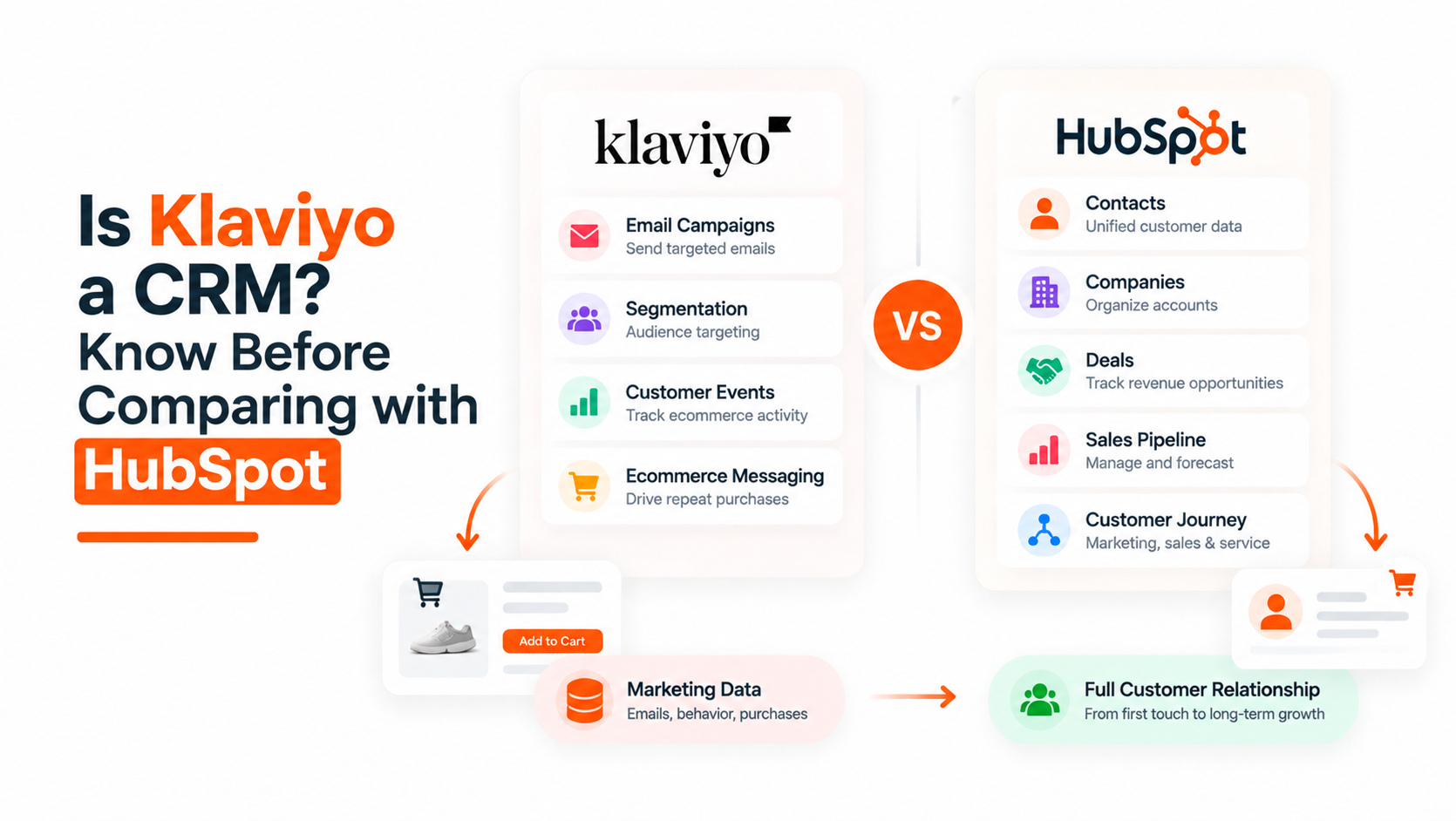
An ecommerce brand picks Klaviyo, sees it marketed as the only CRM built for B2C, and assumes it has covered what a system like HubSpot would otherwise be doing. Then a wholesale order comes in, or a retail partner needs a negotiated deal instead of a checkout link, and there's no deal record, no pipeline, and no company object anywhere in the account.
This happens for two separate reasons, not one. Klaviyo genuinely rebranded part of its product as a CRM, so calling it one isn't a stretch anymore. But the word describes two structurally different tools, and Klaviyo's version doesn't include the one object a B2B sales process actually runs on.
Klaviyo has a real answer to the first confusion and nothing for the second. Knowing which is which decides whether an ecommerce brand needs one platform or two, and it's one of the more common questions that comes up for brands running a HubSpot for ecommerce setup alongside a Klaviyo instance they already have in place.
Why the "Is Klaviyo a CRM" Question Keeps Coming Up
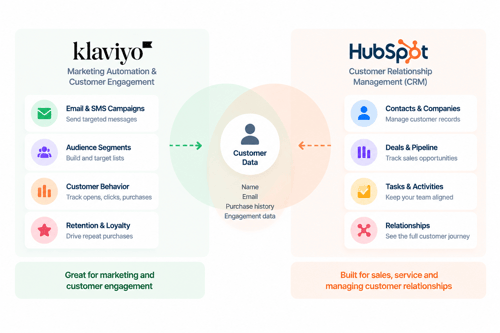
In February 2025, Klaviyo announced Klaviyo B2C CRM, describing it as the only customer relationship management platform built specifically for consumer brands.
The announcement bundled three products under that name: Klaviyo Marketing, Klaviyo Analytics, and a new Klaviyo Service line, which includes a self-serve Customer Hub for order tracking and subscription management (Source: Klaviyo Announces the Only CRM Built For B2C).
Klaviyo's own definition draws the line explicitly: B2B CRMs are built around account-based management and long sales cycles, while its B2C version is built around personalization and high-volume communication with individual consumers.
That rebrand answers half the confusion. The other half predates it. Before Klaviyo ever used the word CRM in its own marketing, users were already asking whether it functioned like one. One Klaviyo Community thread captures this directly: a user asked whether Klaviyo could handle CRM-style data collection for a custom-built site.
And the reply was that Klaviyo can't really be used as a CRM the way a dedicated tool can, since it has no email client to send and receive from and works instead through triggered flows like welcome series and abandoned cart messages. The rebrand changed what Klaviyo calls itself. It didn't change the structural gap that thread was describing.
Where Klaviyo & HubSpot Actually Diverge
Before comparing pricing or campaign features, it helps to see where the two products stop overlapping entirely.
|
Capability |
Klaviyo |
HubSpot |
|
Customer profile |
Unified consumer profile built from behavioral and transactional events |
Contact record, with a separate Company record for account-level data |
|
Deal or pipeline object |
None. Not present in Klaviyo's product or API at any tier |
Deals represent transactions with contacts or companies, tracked through pipeline stages until won or lost |
|
Company or account rollup |
Not modeled. Klaviyo is organized around a single buyer, not a buying group |
Companies can be associated with multiple contacts and deals, with reporting rolled up to the account |
|
Marketing automation |
Flows and campaigns across email, SMS, and push, built on real-time event data |
Workflows across email, forms, and lifecycle stages, tied to the same contact and company records used for sales |
|
Customer service |
Customer Hub and Helpdesk, launched under the B2C CRM umbrella in 2025 |
Ticket pipelines with Open and Closed status per stage, associated with contacts, companies, and deals |
For a pure direct-to-consumer storefront with no sales process behind it, Klaviyo's version of CRM covers the job a system like HubSpot would otherwise be asked to do.
That coverage ends the moment a wholesale account, a rep-managed deal, or a multi-stakeholder purchase enters the picture, because there's no object in Klaviyo to represent any of it.
What Klaviyo's CRM Can Actually Do & What It Can't
This is where most comparison articles either oversell Klaviyo's rebrand or dismiss it outright. Both miss what actually changed.
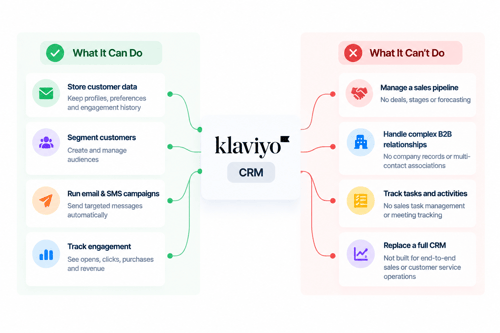
What It Does
Klaviyo unifies profile, event, and transactional data into one system, so a brand can build segments and trigger personalized messages without stitching together separate tools.
The 2025 expansion added a customer-facing Customer Hub, where signed-in shoppers can track orders and manage subscriptions, and a Helpdesk product for support, both positioned as part of the same CRM rather than bolted-on add-ons.
What it Doesn't Do
Klaviyo has no deal, opportunity, pipeline, or quote object anywhere in its product, and this isn't gated behind a pricing tier, it's absent from the platform entirely. Klaviyo's own API documents profiles, events, segments, flows, campaigns, catalogs, coupons, reviews, forms, and conversations as its core objects, with nothing resembling a sales-pipeline object among them.
If a business has any sales process where someone qualifies a lead, moves a deal through stages, or forecasts a quarter, Klaviyo cannot model that process, regardless of what the product is called.
The Gap Both Sides Have to Deal With
Even Klaviyo's newer service tools stay person-centric rather than account-centric. Customer Hub tracks one shopper's orders and subscriptions, not a company's purchase history across multiple buyers, which is a routine question for any B2B or wholesale arm of a business but an unusual one for pure consumer retail.
On the other side, HubSpot's deal object was built around exactly that account relationship from the start, representing transactions with contacts or companies rather than with a single anonymous buyer (Source: HubSpot CRM API, Deals guide).
Deciding Which One You Actually Need
Work through this in order, since the first two questions usually settle it before the rest matter:
- Identify whether any revenue closes through a negotiated deal rather than a self-serve checkout. If every sale completes without a human moving it through stages, a pipeline object may not be necessary at all.
- Check whether any customer is a company with multiple buyers, not a single consumer. Wholesale accounts, retail partners, and B2B resellers all need the account relationship a pipeline is built to hold.
- Separate lifecycle marketing needs from sales-process needs. Abandoned cart flows, post-purchase sequences, and win-back campaigns are lifecycle marketing, and Klaviyo already covers that well regardless of the CRM question.
- If both a consumer storefront and a B2B or wholesale arm exist, plan for two systems from the start rather than trying to force one to cover both. Klaviyo's own one-directional Salesforce sync exists because this pattern is expected, not because it's a workaround (Source: HubSpot vs Klaviyo comparison).
- Decide which system owns the core customer record before connecting the two, since running both without that decision made in advance is what creates duplicate, conflicting profiles later.
The Structural Gap Most Comparisons Skip
Most write-ups on this topic stop at "Klaviyo doesn't have a pipeline" and leave it there. The more useful point is why that's true by design, not by omission.
A B2C CRM is organized around a person: one record, one purchase history, one relationship. A B2B CRM is organized around an account, where the buying unit is a company containing several people who each play a different role, a champion, an economic buyer, a technical evaluator who can block a deal but not approve one.
Klaviyo was built to answer questions about an individual shopper's behavior. It was never built to answer a routine B2B question like how much revenue a single account has generated across several deals over several years.
And no configuration inside Klaviyo changes that, because the account-level object the question depends on doesn't exist in the product.
This is also why running Klaviyo and HubSpot together isn't a sign that either tool failed. Brands with a consumer storefront and a wholesale or B2B arm commonly run Klaviyo for consumer lifecycle marketing while HubSpot holds the B2B pipeline, accounts, and support, connected by an integration with a clear rule about which system owns which record (Source: HubSpot vs Klaviyo comparison).
If You've Already Standardized on Klaviyo & Need a Pipeline Too
If wholesale or B2B revenue shows up after a business has already built its stack around Klaviyo alone, waiting for Klaviyo to add a deal object isn't a realistic plan, since the gap is structural rather than a missing feature on a roadmap.
The practical move is adding a second, purpose-built system for the pipeline rather than trying to simulate one inside Klaviyo with tags, lists, or custom properties. A tag can mark a contact as a wholesale lead.
But it can't track deal stage, deal value, or which of several contacts at that company is the actual decision maker, and stretching Klaviyo's event and segment model to cover that usually produces something more fragile than a real pipeline object.
Keep Klaviyo as the system of record for consumer lifecycle marketing, since that's what it was built for and does well. Let the new system, whether that's HubSpot or something smaller, own the deal, the company, and the sales-stage reporting.
Define the handoff early: what triggers a contact moving from Klaviyo's marketing flows into the sales pipeline, and what data needs to sync back once a deal closes. That decision is easier to make once, before both systems accumulate months of separately-tracked customer history, than to untangle later.
FAQs
Is Klaviyo officially a CRM?
Yes, as of February 2025, when Klaviyo launched Klaviyo B2C CRM, bundling its marketing, analytics, and new customer service tools under that label. It's an accurate description of what Klaviyo now sells, not a stretch of the term.
Does Klaviyo have a sales pipeline like HubSpot?
No. Klaviyo has no deal, pipeline, opportunity, or quote object in its product or its API, at any pricing tier. This is a structural absence, not a feature waiting to be unlocked on a higher plan.
Can Klaviyo replace HubSpot for an ecommerce brand?
For a pure direct-to-consumer storefront with no negotiated sales process, Klaviyo's CRM covers what HubSpot would otherwise be asked to do. If any revenue involves wholesale accounts, rep-managed deals, or multiple stakeholders at one company, Klaviyo has no object to model that relationship, and HubSpot or a comparable system still fills that gap.
What's the real difference between a B2C CRM and a B2B CRM?
A B2C CRM organizes data around a single consumer and their purchase history. A B2B CRM organizes data around an account, where a company contains multiple contacts who play different roles in a single purchase decision. Klaviyo is built for the first case, HubSpot for both.
Can I run Klaviyo and HubSpot together?
Yes, and it's a common setup for brands with both a consumer storefront and a B2B or wholesale arm. Klaviyo handles consumer lifecycle marketing, HubSpot holds the pipeline and account data, and the two connect through an integration with a clear rule about which system owns the core customer record.
Founder & CEO @ Hubxpert. My goal is to make every company using HubSpot succeed in their marketing organisation and automation.

Ratul Rahman
Table of Contents:

Subscribe to our newsletter

Modern Web App Design & UI Patterns That Scale
See how modern web app design differs from a marketing site, covering modern web application design and modern web app UI design for dense data dashboards.

Modern Responsive Web Design Techniques for 2027
Apply modern responsive web design techniques in 2026. Review modern web design best practices and why responsive design still decides your conversions.

Modern Website Design Examples & What Makes Them Work
Browse modern website design examples and modern looking websites, and see exactly what separates a fast, current site from one that already feels dated.

Interactive Web Design Templates & Examples to Study
See interactive web design templates and the best interactive web design inspiration, then compare interactive web page design examples before you build.

Interactive Elements in Web Design & Where to Stop
Add interactive elements in web design that earn their place, covering micro interactions, interactive maps, interactive timelines and knowing when to stop.
3D Web Design Templates & Examples You Can Reuse
Browse 3D web design templates and examples, plus where to find free downloads, and see how 3D web page design lifts a site without slowing the site down.
-
Modern Web App Design & UI Patterns That Scale
hello
-
Modern Responsive Web Design Techniques for 2027
hello
-
Modern Website Design Examples & What Makes Them Work
hello
-
Interactive Web Design Templates & Examples to Study
hello
-
Interactive Elements in Web Design & Where to Stop
hello
-
3D Web Design Templates & Examples You Can Reuse
hello