




-2.png)
-2.png)

.png)

.webp)
.png)

.png)





-1.webp)
-1.webp)

.webp)
-1-1.webp)


-2.webp)
-1-1.webp)
-2-1.png)
-1-1.webp)
-1-1.webp)
-1-1.png)



Search "HubSpot reseller" and you land on the Solutions Partner Program. Search "HubSpot white label" and you land on agencies like ours. Different pages, because they're different things, and mixing them up is how agencies end up in the wrong program or the wrong contract.
Quick version: the partner program is a direct relationship with HubSpot, built on commission and tier status, not a license you buy and resell. "Reseller" is just an old habit of speech, it stuck around but doesn't describe how the program actually pays.
White label is different. It's an agreement between two agencies, one builds, the other keeps the client, and HubSpot never knows the second agency exists.
What Each Term Actually Means
HubSpot Agency Partner Program (officially the Solutions Partner Program) is HubSpot's own tiered partnership. You apply directly to HubSpot, get evaluated on points earned from deals you source and manage, and move through named tiers as those points accumulate. (HubSpot Solutions Partner Program Benefits) This is the only one of the three that HubSpot itself runs and pays you through.
Reseller isn't a term HubSpot uses for its current program. Back in 2009, HubSpot actually called an early version of this a Value Added Reseller Program, which is probably where the word first attached itself to HubSpot searches and never let go. (HubSpot Launches Site to Help Marketing Agencies Become Partners) The current program doesn't work that way. You don't buy licenses wholesale and mark them up. You register deals, you deliver or manage the client, and HubSpot pays you a share of what the client pays them.
White label has nothing to do with HubSpot's partner mechanics at all. It's a private contract between your agency and a delivery partner, where that partner builds the actual HubSpot work and ships it back under your logo, your templates, your email domain if you want. Your client signs with you. They never hear the delivery partner's name. HubSpot isn't a party to this, which is exactly why it's the fastest of the three to set up.
White Label Vs. Referral Vs. Reselling: The Distinction That Actually Matters
Agencies often lump these together because all three involve "someone else doing HubSpot work." The difference that actually affects your P&L is who keeps the client and who keeps the margin.
A referral hands the client to another provider entirely. You get a one-time or short-term fee, and the provider now owns that relationship, including any renewal, upsell, or future project. You've traded a client for a finder's fee.
Reselling, in the loose sense most people mean it, usually describes pointing a client toward HubSpot itself and collecting commission through the partner program, without doing implementation work. You keep a revenue stream, but you're not the one building anything, and the client's actual HubSpot relationship may still run through someone else's managed account.
White label keeps the client and the margin with you, full stop. You set the price, you own the contract, you're the only name the client knows. The delivery partner bills you at a lower rate than you bill the client. That gap is yours. Nothing about this requires you to register a deal with HubSpot or hold any tier status yourself.
If what you're protecting is the long-term client relationship and the recurring revenue that comes with it, white label is the only one of the three built for that.
The Solutions Partner Program, In Plain Terms

If you want to become a HubSpot partner yourself rather than outsource delivery, here's what that looks like now. As of 2026, the program runs on a points system HubSpot calls the Deal-Based Tiers model, which replaced the older untiered releveling process in February 2026. (HubSpot Solutions Partner Program Benefits) You earn points for deals you originate (sourced) and for subscriptions you actively manage after the sale (managed). A deal HubSpot's own sales team closes without your involvement earns you nothing.
Starting July 15, 2026, HubSpot is folding its old untiered and provider entry points into one program, with a $400 per month membership fee to join. That fee is waived if your net product subscription already clears $400 a month after discounts.
So for most active agencies it functions more as a floor under inactive partners than a new cost. (HubSpot Solutions Partner Program Benefits) The tier ladder runs Solutions Partner (entry level), Gold, Platinum, Diamond, and Elite, with Elite sitting at invitation-only status above the rest.
This is worth pursuing in its own right, but it's a HubSpot relationship, not a staffing solution. It doesn't hand you developers or admins. If your actual problem is capacity, tier status alone won't fix it.
Which Hubspot Work Is Actually Worth White-Labeling
Not every task is worth handing off, and not every agency needs all of it. The work that tends to make sense to white label shares a pattern: it needs a certification or specialist skill you don't keep on staff year-round, and getting it wrong is expensive to fix after the fact. In practice, that covers six areas:
- Onboarding and implementation, including CMS theme and module development, standing up a client's portal the right way the first time.
- Web design and development, custom sites and digital experiences built on the platform the client is already using.
- CRM implementation and migration, moving a client off Salesforce, Zoho, Pipedrive, Dynamics, or a legacy system without losing data in the process.
- Marketing automation, the workflow and lifecycle layer that turns a CRM into something the client's team actually runs on day to day.
- Reporting and dashboards, attribution and revenue reporting built to sit inside your agency's own reporting, not someone else's.
- Ongoing support and admin, the ordinary maintenance and troubleshooting that keeps a portal healthy after launch, without tying up a senior person on tickets.
What usually doesn't need white-labeling is anything core to how you position your agency. If strategy and account management are your pitch, keep those in-house and hand off the technical build underneath them.
How The Engagement & Pricing Actually Work
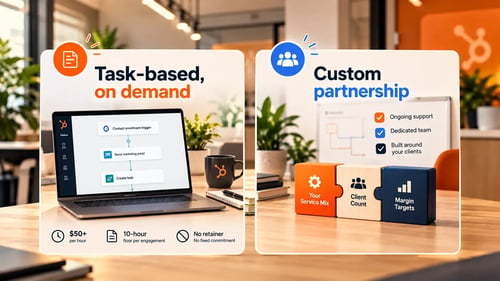
Most white label work runs one of two ways, and which one fits depends on volume, not agency size.
Task-based, on demand. You send a scoped task, workflow builds, reporting, troubleshooting, portal audits, whatever the client needs, and pay for the hours used. At HubXpert this runs $50+ an hour with a 10-hour floor per engagement, no retainer and no fixed monthly commitment. This is the right starting point if you're handling one or two clients, or testing a delivery partner for the first time.
Custom partnership. Once volume is steady enough that you're sending work every month, a custom scope built around your service mix, client count, and margin targets makes more sense than paying task rates each time. This is where most agencies land after six months or so of regular on-demand work.
There isn't a third tier beyond that worth inventing. Agencies that need more structure than on-demand but aren't yet at retainer volume usually just run on-demand longer, there's no penalty for staying there.
How To Vet A White Label Partner Before You Commit
The partner is invisible to your client, which means their mistakes surface as your mistakes. A few checks before signing anything save a lot of damage control later.
Start small, on purpose. Give a new partner one real, bounded task before handing over a retainer's worth of work. How they handle scope, timeline, and revisions on something small tells you almost everything about how they'll handle something large.
Check who's actually doing the work. A partner's website can list certifications that the person assigned to your project doesn't personally hold. Ask directly who's working the task and what they're certified in.
Watch the first deadline. A partner who flags a risk early, even an uncomfortable one, is more trustworthy than one who goes quiet and explains late. Response speed during a pilot is usually the best version of response speed you'll get once you're a regular client.
Confirm the NDA and branding terms before work starts, not after. Everything client-facing (documentation, reports, any call they join) should carry your branding, and the partner should never contact your client directly under any circumstance, disclosed or not.
Be suspicious of pricing that's dramatically below the rest of the market. Certified HubSpot work has a real cost. If a quote is far cheaper than everyone else's, the difference usually comes out of QA, the seniority of who's assigned, or both.
If a partner fails any of these before the first project even ships, that's information, not a reason to negotiate harder.
Comparing The Three Routes
|
Apply as a Solutions Partner |
Refer or resell only |
White label delivery |
|
|
Who you work with |
HubSpot directly |
HubSpot directly |
A delivery agency like HubXpert |
|
What you're building |
Your own tier status and track record |
A commission stream on deals you register |
Delivery capacity under your brand |
|
Client relationship |
Yours |
Often not yours anymore |
Yours, always |
|
Time to first client |
Weeks to months (application, certification) |
Fast, mostly paperwork |
Days, once scope is agreed |
|
Best fit |
Agencies that want HubSpot delivery as a core, long-term practice |
Agencies happy to be a lead source, not a builder |
Agencies that already own the client, need capacity, not status |
These aren't mutually exclusive. A fair number of HubXpert's agency partners hold their own Solutions Partner status and still send us overflow or specialist work, because tier status doesn't scale with a hiring freeze and a client deadline does.
This is Where HubXpert Helps
We run HubSpot white label delivery across all six service areas above, for agencies that have the client relationship already and need the technical bench without the hire. The full breakdown, pricing, and process is on our HubSpot white label page. If you're weighing HubSpot partner status for your own agency before anything else, why working with a HubSpot partner matters is a better next read than this one.
For a client that needs to move off a legacy CRM specifically, our HubSpot migration service covers that end to end, and our HubSpot onboarding page covers getting a client live for the first time, direct or white labeled under your brand.
FAQs
Is HubSpot's partner program the same as being a reseller?
No. HubSpot pays partners a revenue share on deals they source or manage, not a wholesale discount you mark up and resell. The word "reseller" stuck around from an early version of the program HubSpot ran in 2009, but it doesn't describe how the current Solutions Partner Program pays out.
What's the real difference between white label and a referral?
A referral hands the client and the ongoing relationship to someone else for a fee. White label keeps the client, the contract, and the margin with you, the delivery partner stays invisible and bills you at a lower rate than you bill the client.
Can I white label HubSpot work without becoming a HubSpot partner myself?
Yes. White label delivery is a separate agreement with a delivery agency, not a HubSpot program. You don't need any HubSpot partner status to use it, your delivery partner typically already holds that status and does the technical work under their own certifications.
Will my client know HubXpert is involved if I white label the work?
No, not unless you choose to bring us onto a call under your own identity. Every engagement runs under NDA, documentation and communication carry your branding, and we don't contact your client directly.
How do I know if a white label partner is cutting corners?
Pricing far below market rate is the first warning sign, since certified HubSpot work has a real cost. Slow or vague responses during a small pilot project, and uncertainty about who specifically is assigned to your work, are the next two to watch for.
Do I need a minimum number of clients to start white labeling HubSpot work?
No. Task-based engagements, including ours, run on a per-project or hourly basis with no retainer requirement, so a single client project is enough to start.
Final Thought
If you came in searching all three of these terms at once, the honest answer is probably that you don't need all three. Most agencies in this position need one thing fast: a way to say yes to a client's HubSpot request without hiring a specialist they can't keep busy between projects. That's a white label conversation, not a partner application.
The partner program is worth pursuing separately, on its own timeline, once HubSpot delivery becomes a big enough part of your business that owning the tier status actually pays for itself.
Founder & CEO @ Hubxpert. My goal is to make every company using HubSpot succeed in their marketing organisation and automation.

Ratul Rahman
Table of Contents:

Subscribe to our newsletter
HubSpot Agency Partner Program Reseller White Label Routes
See how the HubSpot agency partner program, reseller and white label routes differ, then set up a white-labeled partner portal that clients actually use.
Do You Need a Healthcare-Specific CRM, or HubSpot?
Some practices outgrow HubSpot. Most don't. Here is the real threshold test, and where a healthcare-specific CRM actually wins.
Referral Tracking Software or Your CRM? A Healthcare Guide
HubSpot has no native referral object. Here is how referral tracking actually gets built inside a CRM, and when you need dedicated software instead.
HubSpot at Enterprise Scale: Fix Pipeline Velocity First
Slow pipeline velocity often gets blamed on HubSpot outgrowing enterprise needs. Here's how to diagnose the real cause before a costly Salesforce migration.
Syncing Invoices Between HubSpot & Your Accounting Software
A healthcare CRM tracks inquiries as records, moves them through a visible pipeline, and automates the follow-up. Here is how.

CRM for Healthcare: How It Actually Works Day to Day
A healthcare CRM tracks inquiries as records, moves them through a visible pipeline, and automates the follow-up. Here is how.
-
HubSpot Agency Partner Program Reseller White Label Routes
hello
-
Do You Need a Healthcare-Specific CRM, or HubSpot?
hello
-
Referral Tracking Software or Your CRM? A Healthcare Guide
hello
-
HubSpot at Enterprise Scale: Fix Pipeline Velocity First
hello
-
Syncing Invoices Between HubSpot & Your Accounting Software
hello
-
CRM for Healthcare: How It Actually Works Day to Day
hello