


-2.png)
-2.png)

.png)

.webp)
.png)


.png)




-1.webp)
-1.webp)

.webp)
-1-1.webp)


-2.webp)
-1-1.webp)
-2-1.png)
-1-1.webp)
-1-1.webp)
-1-1.png)


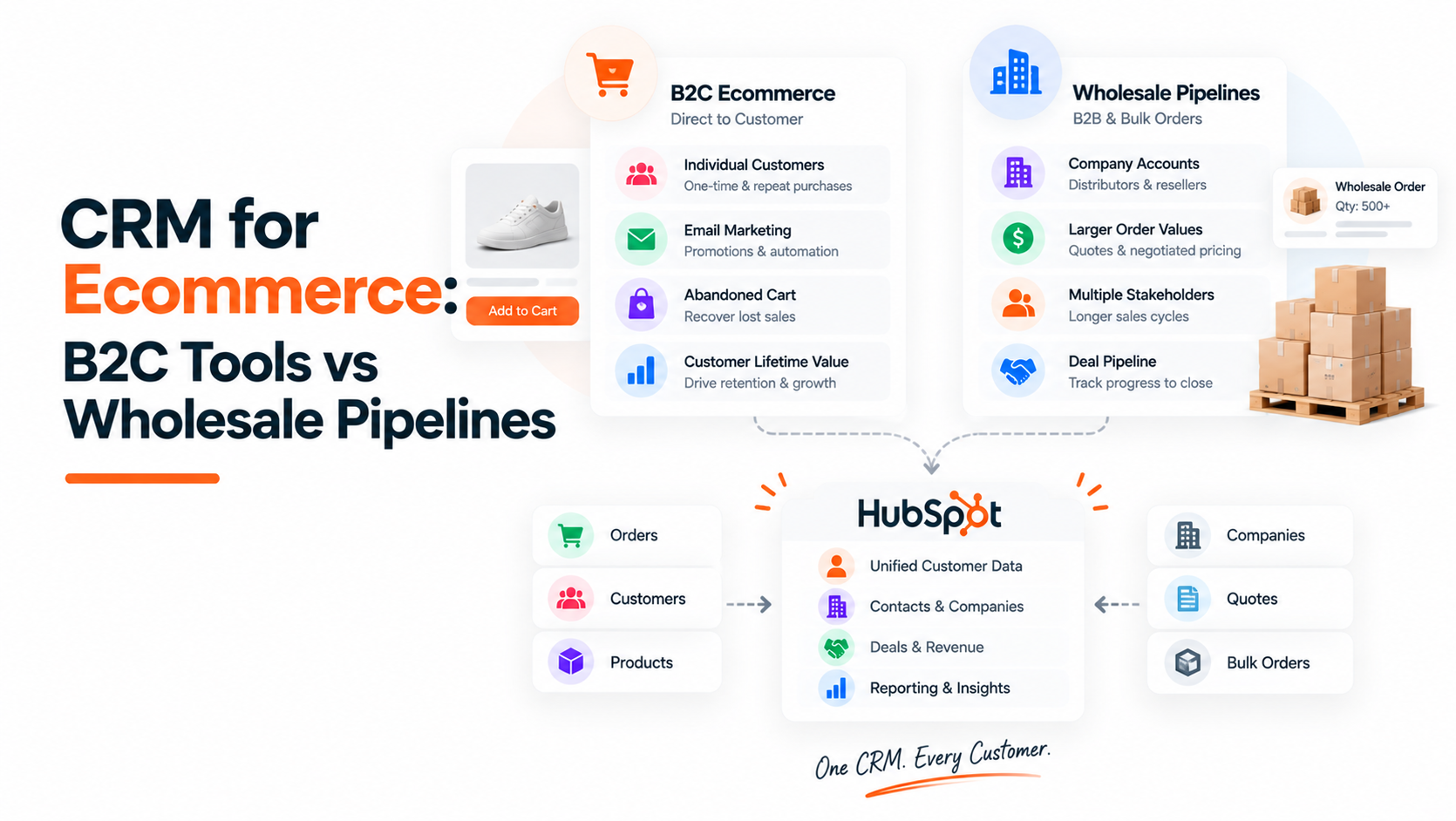
When a DTC brand starts growing its wholesale channel, things get complicated fast. Retail partners need company records, multiple contacts, negotiated terms, and deals that move through sales stages, things a typical B2C marketing tool wasn't built to handle.
The key difference is simple: B2C is built around individual customers; wholesale is built around business accounts. Understanding that difference is the first step toward choosing the right CRM setup.
Let’s keep reading to know more about ecommerce CRM and which one is best for your business.
Why "CRM for Ecommerce" isn't One Category
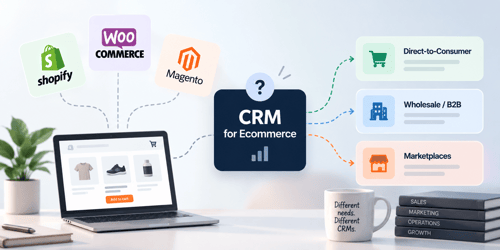
A B2C CRM is built to answer questions about an individual consumer: what did they buy, what should they see next, when should they hear from the brand again. Klaviyo's own definition draws this line explicitly, describing B2C CRM as tailored to personalization and high-volume communication with individual consumers, as opposed to B2B CRM, which is built around account-based management and longer sales cycles (Source: What is a B2C CRM? Definition & FAQs, Klaviyo, official).
That's not marketing language, it describes an actual product decision: no deal object, no company object, one profile per buyer.
A B2B or wholesale CRM is built to answer a different question entirely: how much is this account worth, where is this deal in the process, who else at this company needs to sign off. HubSpot's own deal object documentation states this directly, a deal represents a transaction with a contact or a company, tracked through pipeline stages until it's won or lost (Source: HubSpot CRM API, Deals guide, HubSpot, official).
That object, and the account relationship underneath it, is exactly what a B2C tool doesn't have. For a deeper look at what this specific gap looks like tool by tool, Is Klaviyo a CRM? What Ecommerce Brands Should Know Before Comparing It to HubSpot covers the API-level detail.
Match the Tool to the Motion, Not the Brand
The question isn't which CRM is better. It's which motion each part of the business is actually running, since the two need different objects to track them.
|
B2C marketing tool |
B2B / wholesale pipeline |
|
|
Core object |
Customer profile, built from behavioral and transactional events |
Deal, associated with a contact and a company, tracked through stages |
|
What it's built to answer |
What should this person see next, and when |
Where is this account in the buying process, and what's it worth |
|
Example platforms |
Klaviyo, Mailchimp |
HubSpot, Salesforce |
|
When it fits |
Self-serve checkout, no negotiation, no multi-stakeholder decision |
Negotiated pricing, net payment terms, a buying group with more than one contact |
Most brands with any wholesale or B2B revenue need both, not a replacement for one with the other. A DTC brand running Klaviyo for consumer lifecycle marketing and HubSpot for the wholesale pipeline isn't running redundant tools, it's running two tools built for two different kinds of relationship.
Designing a Two-System Setup That Actually Holds
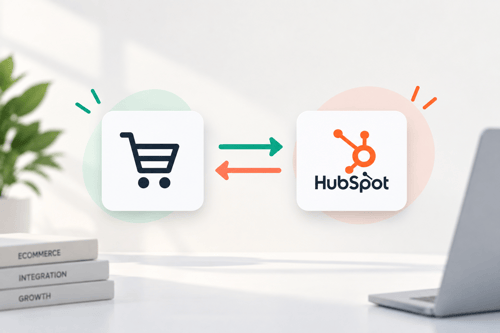
Running two systems only works if the handoff between them is deliberate, not assumed. Build it in this order:
- Decide which system owns the core customer record before connecting anything. Without that decision made first, both systems end up with a slightly different version of the same customer, and nobody can say which one is correct.
- Set an explicit trigger for when a contact moves from the marketing tool into the sales pipeline. A wholesale inquiry form, a minimum order size, or a specific tag are all workable triggers, but there has to be one, rather than a rep noticing and re-keying the record by hand.
- Plan for company association from the start rather than assuming an ecommerce integration provides it. This is rarely automatic even on platforms with strong native sync, and the mechanics of exactly how that gap shows up and how to close it are covered in Why Wholesale Orders Show Up as Orphan Deals in HubSpot.
- Decide where a repeat wholesale order lives. Most ecommerce-to-CRM syncs create a new deal for every order rather than extending an existing one, which quietly breaks account-level reporting if nobody catches it early.
- Log which records were connected automatically versus by hand. That distinction is the only reliable way to tell whether the handoff is actually holding or whether someone is still bridging the gap manually.
The Architecture Problem Most "Best CRM for Ecommerce" Lists Skip
Ranked comparison lists treat this as a maturity problem, as if the right tool, or the next version of an existing one, eventually closes the gap. It won't, because the gap isn't about missing features. It's about which kind of relationship each tool's data model was built to represent, and that's a foundational design choice, not a backlog item.
A person-centric tool can add customer service features, loyalty programs, and better segmentation without ever needing an account object, because none of that requires modeling more than one buyer per relationship.
An account-centric tool can add better automation and nicer reporting without ever needing to drop its deal and company objects, because that structure is what makes account-level answers possible in the first place.
Neither one drifts toward the other by accident, and picking based on feature checklists instead of which relationship type actually needs modeling is how brands end up with a tool that's excellent at its job and still wrong for half the business.
This same divide shows up again at the ecommerce platform layer underneath both CRM types, not just in the marketing and sales tools themselves. Shopify vs WooCommerce vs Magento: Which Syncs Cleanest with HubSpot covers how each platform's own architecture, hosted and controlled versus self-hosted and endlessly configurable, adds its own version of this same inconsistency before the CRM question even enters the picture.
If Your Wholesale Channel Has Already Outgrown Your Marketing Tool
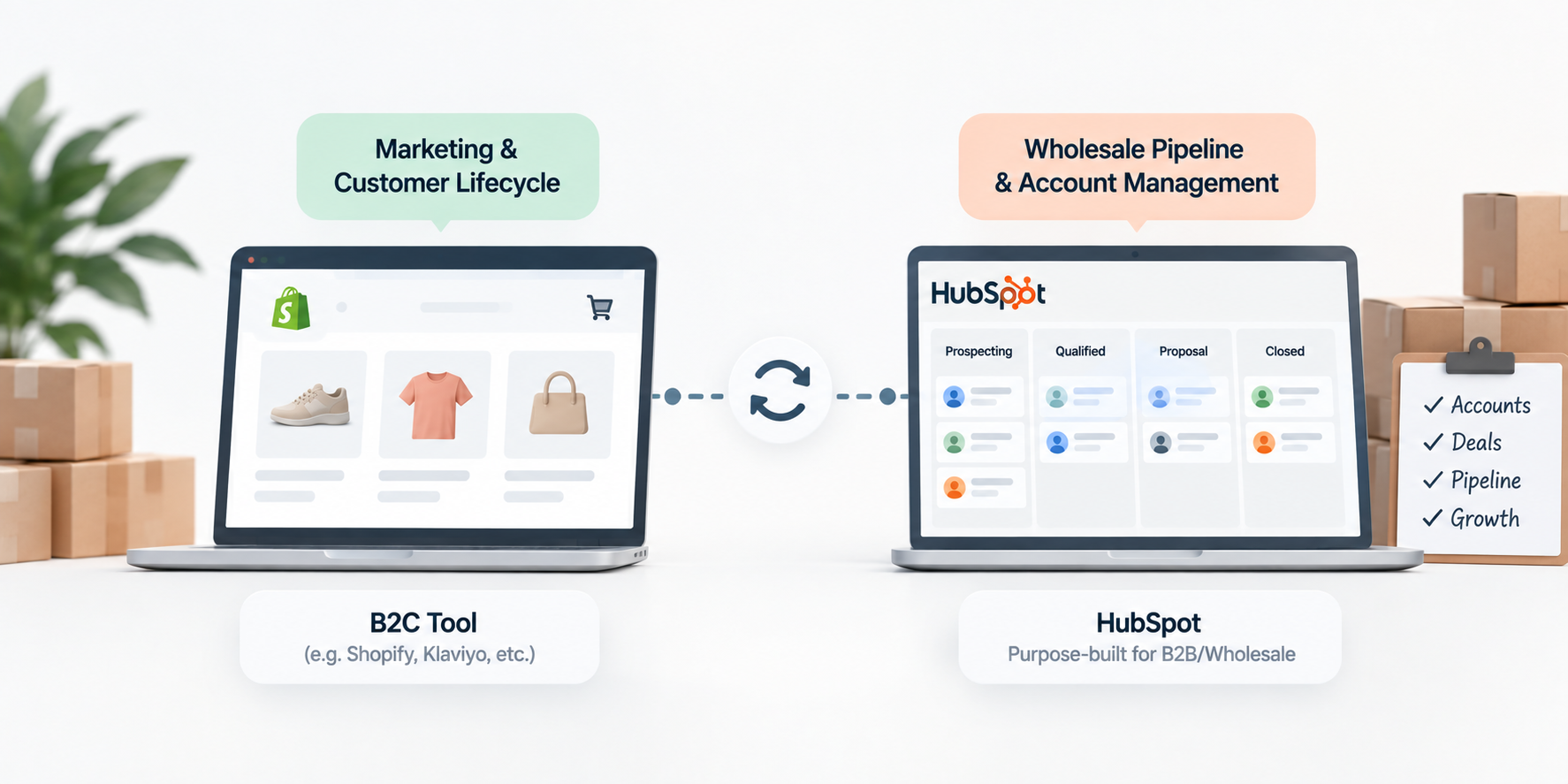
If a brand already runs entirely on a B2C tool and wholesale revenue has outgrown what it can track, waiting for that tool to add pipeline features isn't a realistic plan, since the gap is architectural rather than a missing checkbox on a roadmap.
The realistic move is adding a second, purpose-built system for the pipeline rather than stretching tags, lists, or custom properties to simulate one. A tag can flag a contact as a wholesale lead. It can't hold deal stage, deal value, or track which of several contacts at that account is the actual decision maker, and forcing a person-centric tool to carry that weight usually produces something more fragile than a real pipeline object would have been from the start.
Keep the existing marketing tool doing what it does well, consumer lifecycle marketing, and let the new system own the account, the deal, and the pipeline reporting. Define the handoff before both systems accumulate months of separately tracked history, since that decision only gets harder to make retroactively.
For brands working through exactly this transition, HubSpot for ecommerce covers what that setup looks like in practice once both systems are actually talking to each other.
FAQs
What's the difference between a CRM for ecommerce and a CRM for B2B?
An ecommerce-focused CRM, like Klaviyo, is built around a single consumer profile and their purchase history. A B2B CRM, like HubSpot, is built around an account, where a company can contain multiple contacts, each playing a different role in one purchase decision. They're solving different problems, not competing versions of the same tool.
Can one platform handle both DTC marketing and wholesale sales?
Not fully, in most cases. A B2C marketing tool has no deal or company object to track a negotiated wholesale relationship, and a B2B pipeline tool isn't built for high-volume consumer lifecycle marketing. Most brands running both channels end up running both types of system, connected deliberately rather than replaced by one another.
Do I need a separate CRM for my wholesale channel?
If any revenue involves negotiated pricing, net payment terms, or a buying group with more than one contact at the company, yes. A B2C marketing tool has no object to represent that relationship, regardless of how the rest of the tool performs.
What CRM works with Shopify B2B?
There's no native CRM sync built into Shopify's B2B layer. HubSpot, Salesforce, and Microsoft Dynamics all connect through third-party apps or custom API work against Shopify's B2B API, not an out-of-the-box integration.
How do I connect a B2C marketing tool to a wholesale pipeline?
Start by deciding which system owns the core customer record, then define a clear trigger for when a contact moves from marketing into the sales pipeline. Company association usually needs to be built deliberately rather than assumed, since most ecommerce-to-CRM syncs don't provide it automatically.
Founder & CEO @ Hubxpert. My goal is to make every company using HubSpot succeed in their marketing organisation and automation.

Ratul Rahman
Table of Contents:

Subscribe to our newsletter
HubSpot Agency Partner Program Reseller White Label Routes
See how the HubSpot agency partner program, reseller and white label routes differ, then set up a white-labeled partner portal that clients actually use.
Do You Need a Healthcare-Specific CRM, or HubSpot?
Some practices outgrow HubSpot. Most don't. Here is the real threshold test, and where a healthcare-specific CRM actually wins.
Referral Tracking Software or Your CRM? A Healthcare Guide
HubSpot has no native referral object. Here is how referral tracking actually gets built inside a CRM, and when you need dedicated software instead.
HubSpot at Enterprise Scale: Fix Pipeline Velocity First
Slow pipeline velocity often gets blamed on HubSpot outgrowing enterprise needs. Here's how to diagnose the real cause before a costly Salesforce migration.
Syncing Invoices Between HubSpot & Your Accounting Software
A healthcare CRM tracks inquiries as records, moves them through a visible pipeline, and automates the follow-up. Here is how.
CRM for Healthcare: How It Actually Works Day to Day
A healthcare CRM tracks inquiries as records, moves them through a visible pipeline, and automates the follow-up. Here is how.
-
HubSpot Agency Partner Program Reseller White Label Routes
hello
-
Do You Need a Healthcare-Specific CRM, or HubSpot?
hello
-
Referral Tracking Software or Your CRM? A Healthcare Guide
hello
-
HubSpot at Enterprise Scale: Fix Pipeline Velocity First
hello
-
Syncing Invoices Between HubSpot & Your Accounting Software
hello
-
CRM for Healthcare: How It Actually Works Day to Day
hello