-2.png)

-2.png)
.png)
.webp)
.png)

.png)



-1.webp)
-1.webp)

.webp)
-1-1.webp)

-2.webp)
-1-1.webp)
-2-1.png)
-1-1.webp)
-1-1.webp)
-1-1.png)


.webp)
HubSpot's website builder lives inside what the company now calls Content Hub, previously CMS Hub. It is a drag-and-drop page editor with a CRM underneath it, and that pairing is the actual difference from a standalone site builder: a form submission or a page visit on a HubSpot-built site writes straight into a contact record, with no separate analytics tool or integration required to make that connection.
This post covers what the builder actually includes at each plan tier with current 2026 pricing, the real steps to build and publish a page in it, and a direct comparison against Wix, Squarespace, and WordPress.com on cost and features, not just a generic "it depends" answer.
What HubSpot's Website Builder (Content Hub) Actually Is?
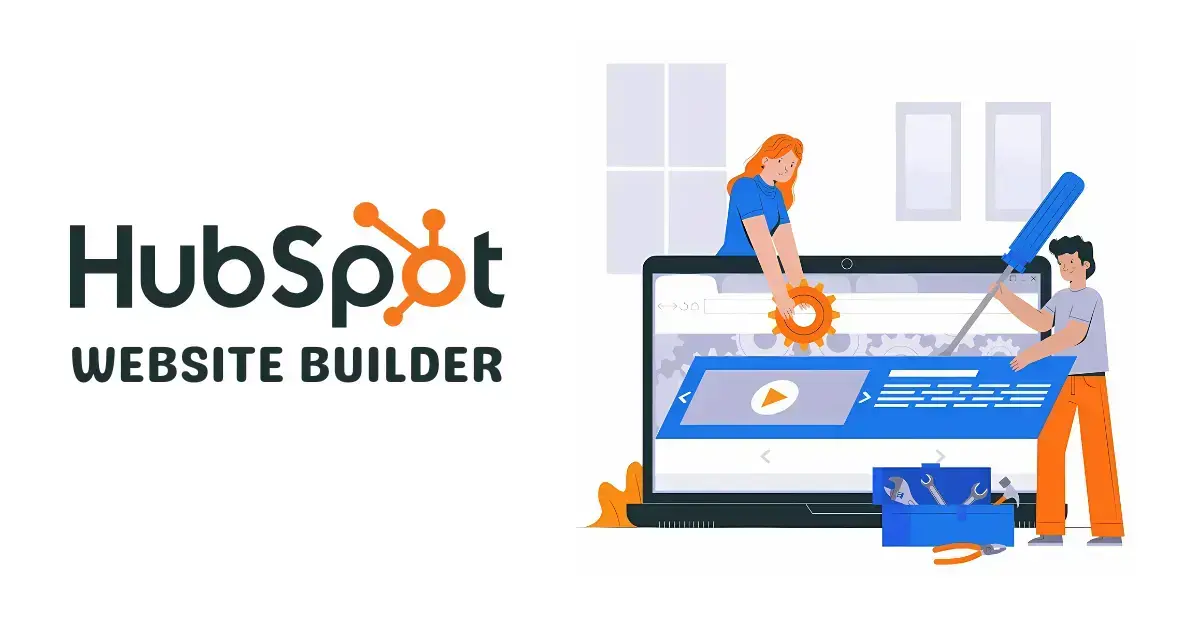
Content Hub is HubSpot's CMS product: page hosting, a drag-and-drop editor, a template and theme system, and (on paid tiers) SEO and personalization tools, all built on the same database as HubSpot's CRM, Marketing Hub, and Sales Hub. A page built in Content Hub is not a separate system that later syncs to HubSpot, it is a HubSpot object from the start, which is why form fills and page views show up on a contact's timeline immediately with no Zapier step or webhook in between.
The practical effect: a business already running its sales pipeline or marketing emails through HubSpot gets its website behavior folded into the same reporting and automation it already has. A business with no plans to use HubSpot for anything else is paying for a CMS with CRM machinery attached whether it uses that machinery or not, which matters directly to whether the higher tiers are worth it, covered below.
How to Actually Build a Website in HubSpot
This is the part most explanations of Content Hub skip. Here is the actual sequence, from an empty account to a published page.
-
Pick a theme or start blank. HubSpot's Theme Marketplace has free and paid themes built by HubSpot and by third-party developers, each with a matching set of drag-and-drop modules (headers, testimonial blocks, pricing tables, forms). Starting from a theme is faster for most businesses; starting blank gives full control but means building every module's styling from scratch.
-
Set up domain and pages. On Free and Starter, pages live under a HubSpot-hosted domain unless you connect your own (a custom domain requires Starter or above). Content Settings is where you set the site's default meta description pattern, favicon, and blog settings before building individual pages.
-
Build pages in the drag-and-drop editor. Modules from the active theme go into content areas by dragging them in; each module has its own settings panel (a testimonial module's settings might include the quote text, name, and photo, for example) rather than requiring HTML edits. Global content, a header or footer used across every page, is edited once and updates everywhere it is placed.
-
Connect forms to the CRM. Any HubSpot form dropped onto a page creates or updates a contact record automatically on submission. This step needs no separate configuration, it is the default behavior, which is the main practical difference from building the same page in WordPress or Wix and then connecting a form plugin to a CRM afterward.
-
Set on-page SEO fields and publish. The page settings panel includes title tag, meta description, and URL slug fields, plus (on Professional and above) content-strategy and topic-cluster recommendations. Publishing is a single button, and HubSpot generates an XML sitemap automatically rather than requiring a separate plugin.
For a team coming from WordPress, the adjustment is mostly about where things live: styling comes from theme and module settings rather than a page builder plugin plus a separate CSS file, and there is no plugin folder to manage, HubSpot's own modules and any purchased marketplace assets cover that role.
Content Hub Pricing by Plan (2026)

|
Plan |
Cost |
What It Includes |
|---|---|---|
|
Free |
$0/month |
Basic hosting, up to 30 website pages, 30 landing pages, fundamental on-page SEO fields |
|
Starter |
$15/month billed annually ($20/month billed monthly) |
Custom domain, removes HubSpot branding, basic AI writing tools, smart content rules, lead capture, email marketing, premium templates |
|
Professional |
$450/month billed annually ($600/month billed monthly) |
Advanced AI content writer, content repurposing, unlimited blogs and landing pages, SEO tools with competitive analysis, dynamic personalization, A/B testing, advanced analytics and attribution |
|
Enterprise |
From $1,500/month |
Multi-site management up to 10 root domains, content partitioning, structured content up to 1 million custom object records, enterprise-grade AI tools, full-funnel attribution reporting, sandbox environment, single sign-on |
The free and Starter tiers cover a small business brochure site with no personalization. The jump to Professional is a real one in both price and capability: dynamic content by lifecycle stage or list membership and true A/B testing are Professional-tier features and are not available on Free or Starter at any price (Source: "HubSpot Content Hub Pricing")
Core Features
-
Drag-and-drop editor: page layout without writing HTML, using pre-built modules for forms, images, text, and theme-specific sections like pricing tables or testimonial grids.
-
Built-in SEO recommendations: on-page suggestions for title tags, meta descriptions, and internal linking, surfaced while editing rather than as a separate audit run afterward.
-
CRM-connected forms: a form submission creates or updates a contact record automatically, with no separate integration to configure.
-
Mobile-responsive templates: layouts adjust by breakpoint automatically, though custom-coded modules still need to be built responsively on purpose.
-
Smart Content, Professional and above: shows different content blocks to different visitors based on lifecycle stage or list membership, the same personalization engine used in HubSpot email (Source: "HubSpot Smart Content Documentation")
-
AI content tools: a basic AI writing assistant on Starter, expanding to an advanced AI content writer and AI-assisted content repurposing on Professional, both used inside the same editor rather than a separate tool.
HubSpot vs. Wix, Squarespace, and WordPress.com

These four solve different problems, and the honest comparison is on price at comparable feature levels, not just "which is cheapest."
|
Platform |
Entry Paid Tier |
Mid Tier |
What Sets It Apart |
|---|---|---|---|
|
HubSpot Content Hub |
Starter, $15/mo annual |
Professional, $450/mo annual |
Native CRM, so page and form activity write to contact records with no integration step |
|
Wix |
Light, $17/mo annual |
Business, $39/mo annual |
Largest app marketplace of the four, fastest visual builder for a from-scratch design |
|
Squarespace |
Basic, $19/mo annual |
Core, $29/mo annual |
Design templates are the strongest of the four out of the box, plus built-in ecommerce from the entry tier |
|
WordPress.com |
Personal, $4/mo annual |
Business, $25/mo annual |
Cheapest entry point and, on the Business plan, full plugin installation for near-unlimited extensibility |
WordPress.com
The cheapest way into a real website, and the most flexible through its plugin ecosystem once you reach the Business plan, which adds plugin installation and SFTP access. That flexibility comes with ongoing maintenance HubSpot handles for you on its own platform: plugin updates, security patches, and hosting management. No native CRM, so a plugin or external tool is required to connect form submissions to a contact database, and that connection is a separate thing to configure and keep working.
Wix
Faster to launch than WordPress and built around drag-and-drop design rather than a plugin architecture, with the largest app marketplace of the four for bolting on extra functionality. Ecommerce is available from the Core tier up. No CRM comparable to HubSpot's, form data stays inside Wix's own contact list feature rather than feeding a sales pipeline.
Squarespace
The strongest default design quality of the four, aimed at businesses that want a good-looking site fast with minimal customization work. Built-in ecommerce starts on the Basic plan, with store transaction fees that drop to 0% at the Core tier and above. No CRM, no workflow automation, no lifecycle-stage personalization, form submissions go to email or a basic contact list, not a sales database.
Where HubSpot Wins, and Where It Does Not
If a business already runs its sales and marketing through HubSpot, or plans to, building the website on the same platform means visitor behavior, form fills, and page views feed the CRM automatically, something none of the other three can replicate without a separate integration layer. If a business has no plans to use HubSpot's CRM, sales, or marketing tools at all, paying Professional-tier pricing for a website alone is hard to justify against Squarespace or Wix at a fraction of the cost with comparable design quality.
Is HubSpot Good for an Online Store?
Content Hub includes ecommerce functionality, but it is not built primarily as a standalone webshop platform the way Shopify or WooCommerce is. It works well for a business selling a small number of products or services alongside a marketing site that already runs on HubSpot, since product pages and checkout activity feed the same CRM as everything else. For a business whose main need is a full-featured online store first and a marketing site second, particularly one with a large product catalog or complex inventory needs, a dedicated ecommerce platform is usually the better starting point, with HubSpot connected afterward for the CRM and marketing side if needed.
Who This Is Actually For
A good fit: a business already using HubSpot for sales or marketing that wants its website generating the same contact and behavior data those tools already use, or one planning to adopt HubSpot across marketing and sales together rather than piecing together separate tools.
A weaker fit: a business that needs highly custom design or complex functionality WordPress plugins handle better, or one with no plans to use HubSpot's CRM at all, since paying HubSpot's Professional-tier price for a website with no CRM use behind it is a hard case to justify against a cheaper platform.
Common Questions
Is HubSpot's website builder free?
Yes, the Free plan supports up to 30 website pages and 30 landing pages with basic hosting and on-page SEO fields. Removing HubSpot branding and adding a custom domain requires the Starter plan.
Do I need Content Hub Professional to personalize my website?
Yes. Dynamic Smart Content, which shows different page content by lifecycle stage or list membership, is a Professional-tier feature and is not available on Free or Starter.
Can I move an existing WordPress site to HubSpot?
Yes, through HubSpot's CMS migration tools or a manual rebuild, though page count and any custom plugin functionality determine how much of that is a straight import versus a rebuild.
How long does it take to build a website in HubSpot?
A small brochure site built from an existing theme, five to ten pages with no custom-coded modules, typically takes a few days to two weeks for one person working part-time on it. A site needing custom modules, a migration of existing content, or Professional-tier personalization logic runs longer, closer to four to eight weeks, largely driven by content and design decisions rather than the platform itself.
Is HubSpot Content Hub good for ecommerce?
It handles a smaller product catalog sold alongside a marketing site reasonably well, especially when the business already runs on HubSpot for CRM and marketing. It is not built as a dedicated storefront platform, so a business whose primary need is a large-catalog online store is usually better served starting on a dedicated ecommerce platform.
Conclusion
HubSpot's website builder is a genuine CRM-connected alternative to WordPress, Wix, and Squarespace, not a marketing feature bolted onto the CRM as an afterthought. The free and Starter tiers cover a small brochure site, the real capability jump happens at Professional, where personalization and A/B testing live, and the deciding factor throughout is whether the business already runs, or plans to run, its sales and marketing on HubSpot. If you are trying to work out whether your site belongs on HubSpot or should stay on what you already run, HubXpert's HubSpot admin and technical support team can walk through the real cost and migration effort for your specific site.
As a Hubspot Automation Developer at Hubxpert, I specialize in API integration, seamlessly connecting HubSpot with third-party applications. My role encompasses understanding client needs, crafting custom code solutions, and ensuring the smooth operation of our automation workflows. I actively address any HubSpot integration challenges and stay updated with the platform's latest advancements. My dedication ensures clients harness the full potential of HubSpot.

Tanzinul Kabir
Table of Contents:

Subscribe to our newsletter

Modern Website Design Examples & What Makes Them Work
Browse modern website design examples and modern looking websites, and see exactly what separates a fast, current site from one that already feels dated.

Interactive Web Design Templates & Examples to Study
See interactive web design templates and the best interactive web design inspiration, then compare interactive web page design examples before you build.

Interactive Elements in Web Design & Where to Stop
Add interactive elements in web design that earn their place, covering micro interactions, interactive maps, interactive timelines and knowing when to stop.

3D Web Design Templates & Examples You Can Reuse
Browse 3D web design templates and examples, plus where to find free downloads, and see how 3D web page design lifts a site without slowing the site down.

3D Web Design Tools & Software Compared for 2026
Compare 3D web design tools and web based 3D design software, and see where 3D models and 3D assets for web design fit your existing front-end build pipeline.

HubSpot Onboarding Cost: What the Fee Really Covers
See what HubSpot onboarding cost covers, how onboarding fees get quoted and how to compare implementation quotes line by line before you commit to a partner.
-
Modern Website Design Examples & What Makes Them Work
hello
-
Interactive Web Design Templates & Examples to Study
hello
-
Interactive Elements in Web Design & Where to Stop
hello
-
3D Web Design Templates & Examples You Can Reuse
hello
-
3D Web Design Tools & Software Compared for 2026
hello
-
HubSpot Onboarding Cost: What the Fee Really Covers
hello