

-2.png)
-2.png)
.png)
.webp)
.png)

.png)




-1.webp)
-1.webp)

.webp)
-1-1.webp)
-2.webp)
-1-1.webp)
-2-1.png)
-1-1.webp)
-1-1.webp)
-1-1.png)




Cold email is not dead in 2026. Generic cold email is.
Most inboxes are flooded with automated outreach that sounds personalized but feels identical. Buyers can spot mass-produced emails instantly, making relevance and trust more important than ever.
The companies still winning with cold outreach are not sending more emails. They are building better systems around targeting, deliverability, timing, personalization, and follow-up.
In this guide, we'll break down 25 cold email best practices that actually work in 2026, including proven strategies for deliverability, messaging, AI-assisted workflows, subject lines, and reply-generating outreach.
Quick Answer: What Makes a Cold Email Work in 2026?
The best cold email practices in 2026 focus on relevance, deliverability, and human communication.
Successful cold emails are short, personalized with real context, sent from warmed domains, and targeted to smaller high-quality prospect lists. Strong outreach prioritizes conversations, not aggressive sales pitches or mass automation.
Why Cold Email Still Works in 2026
Every year, people claim cold email is dying. Every year, companies continue generating pipeline, partnerships, meetings, and revenue through outbound outreach.
What’s actually happening is simpler: low-quality cold email is becoming easier to ignore. High-quality outreach still works extremely well.
Email Is Still the Highest ROI Outbound Channel
Despite the rise of LinkedIn outreach, paid ads, AI chatbots, and short-form content, email remains one of the highest ROI outbound channels for B2B businesses.
Why? Because email is still where professional conversations happen. Decision-makers may discover brands on social media, but serious discussions usually move into the inbox.
Unlike paid ads, cold email also gives businesses direct ownership over outreach and relationship-building.
AI Increased Spam! But Also Increased Opportunity
AI dramatically increased the amount of low-quality outbound messaging. Thousands of companies now generate mass outreach campaigns in minutes.
The result is predictable: inbox fatigue.
But this also created an opportunity. Since buyers are overwhelmed with generic AI-generated emails, relevant human communication stands out more than ever.
A thoughtful 80-word email now beats a polished 500-word automated pitch in many industries.
Most Companies Still Send Terrible Outreach
Most cold emails fail for the same reasons:
- Generic messaging
- Poor targeting
- Weak deliverability setup
- Long sales pitches
- No real relevance
- Over-automation
- Bad timing
The bar for “good cold email” is honestly still very low.
That’s why companies with proper infrastructure, clear ICP targeting, and strong messaging continue outperforming competitors consistently.
Cold Email vs LinkedIn Outreach vs Cold Calling
Each outbound channel has strengths:
- LinkedIn is strong for visibility and soft networking
- Cold calling works well for urgency and direct conversations
- Cold email works best for scalable, structured outreach
The most effective outbound teams in 2026 usually combine all three instead of relying on one channel alone.
But cold email remains the operational backbone because it scales more efficiently while still allowing personalization and automation together.
Before You Write: The New Rules of Cold Email
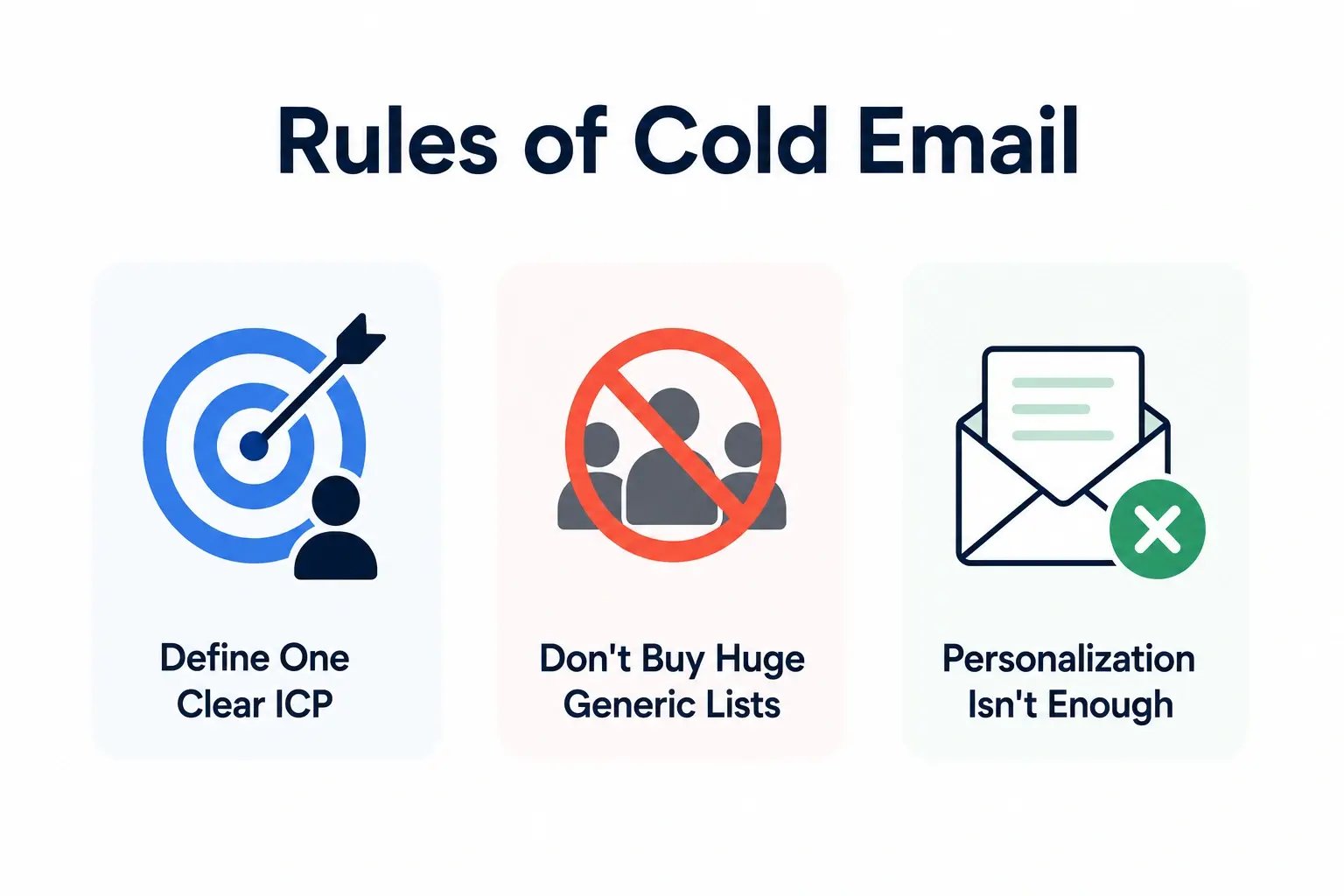 Most cold email campaigns fail before the first email is even written.
The problem is usually not the template. It is the targeting, infrastructure, positioning, or data quality behind the campaign.
In 2026, successful cold outreach started long before copywriting.
1. Define One Clear ICP
A vague target audience creates vague messaging.
Your Ideal Customer Profile (ICP) should clearly define:
- Industry
- Company size
- Decision-maker roles
- Business model
- Pain points
- Buying triggers
- Growth stage
The more specific the ICP, the easier it becomes to write relevant emails that actually resonate.
For example, “marketing agencies” is too broad.
“HubSpot-focused B2B agencies with 10 to 50 employees struggling with outbound pipeline generation” is much more actionable.
2. Stop Buying Massive Generic Lists
Large contact databases look impressive but often destroy campaign performance.
Bad lists create:
- High bounce rates
- Spam complaints
- Low reply rates
- Damaged sending domains
- Poor deliverability
Modern outbound works better with smaller, highly relevant prospect lists built around intent signals and contextual relevance.
Quality consistently beats volume.
3. Separate Infrastructure From Campaigns
One of the biggest mistakes companies make is sending cold outreach directly from their primary business domain.
Cold email infrastructure should be separated properly using:
- Secondary sending domains
- Inbox rotation
- SPF, DKIM, and DMARC setup
- Domain warm-up
- Controlled sending limits
Deliverability is now just as important as messaging quality.
Even great copy fails if emails never reach the inbox.
4. Personalization Is No Longer Enough
Adding someone’s first name is not personalization anymore. Most AI tools can already do that instantly.
Modern cold outreach is about relevance.
Good outreach references something meaningful:
- A hiring trend
- A recent launch
- A company initiative
- A workflow problem
- A market shift
- A growth signal
The goal is to make the email feel timely and context-aware instead of automated.
25 Cold Email Best Practices for 2026
Here are 25 best practices that actually work if you follow these properly. First comes writing & messaging.
1. Write Like You’re a Human
Most cold emails fail because they sound like marketing copy instead of real communication.
People do not naturally speak in corporate phrases like:
- “I hope this email finds you well”
- “Synergize your business growth”
- “Unlock scalable revenue opportunities”
Modern cold email works better when it sounds conversational, direct, and natural.
Write the way an experienced colleague would message someone professionally, not the way a sales brochure sounds.
2. Keep Emails Under 120 Words
Long cold emails create friction.
The goal of a cold email is not to explain your entire service. It is to start a conversation.
In most industries, shorter emails consistently outperform long pitches because they:
- Respect the reader’s time
- Reduce cognitive load
- Feel less sales-heavy
- Increase reply likelihood
If your email requires multiple paragraphs to explain the offer, the positioning is probably unclear.
3. Use One Clear CTA
Too many cold emails end with multiple asks:
- “Want a demo?”
- “Can we schedule 30 minutes?”
- “Would you like pricing?”
- “Should I send more details?”
Multiple CTAs create hesitation.
The best cold emails usually contain one low-friction next step like:
- “Open to seeing how we approached this?”
- “Worth a quick conversation?”
- “Should I send over a short breakdown?”
Simple CTAs reduce pressure and improve response rates.
4. Avoid Long Introductions
Prospects do not care about your company history during the first email.
Many outreach emails waste the opening explaining:
- who the sender is
- when the company was founded
- what services they provide
- how many awards they won
Instead, focus immediately on relevance and context.
The opening should answer one question quickly:
“Why is this email relevant to me?”
5. Focus on Their Problem, Not Your Service
Most cold emails talk too much about features, services, and capabilities.
Strong outreach focuses on the prospect’s operational pain points instead.
Bad approach:
“We provide advanced AI-powered outbound systems.”
Better approach:
“Notice your SDR team is scaling quickly. Many teams hit deliverability problems around this stage.”
The second approach feels more relevant because it centers the prospect’s situation first.
6. Use Trigger-Based Openers
The best cold emails feel timely instead of random.
Trigger-based outreach works because it connects your message to something already happening inside the prospect’s business.
Good triggers include:
- New hiring activity
- Funding announcements
- Product launches
- Leadership changes
- Expansion into new markets
- Increased ad activity
- Website redesigns
- Technology migrations
These signals create natural reasons for outreach instead of forced pitches.
For example:
“Noticed your team recently started hiring SDRs across multiple regions…”
This immediately feels more contextual than a generic introduction.
7. Mention Specific Observations
Specificity builds credibility.
Generic outreach sounds automated because it could apply to almost anyone. Specific observations show real research and attention.
Weak example:
“Loved your company website.”
Stronger example:
“Noticed your onboarding flow still routes demo requests through a generic contact form.”
Specific observations make emails feel more relevant without needing excessive personalization.
8. Remove Buzzwords & Sales Language
Modern buyers instantly recognize sales-heavy language.
Words like:
- revolutionary
- cutting-edge
- game-changing
- industry-leading
- best-in-class
usually reduce trust instead of building it.
Cold emails perform better when they sound practical and grounded.
Simple language feels more believable.
9. Use Soft CTAs Instead of Aggressive Booking Requests
Asking strangers for a 30-minute meeting in the first email creates too much friction.
Most prospects are not ready for a call immediately.
Soft CTAs work better because they continue the conversation naturally.
Examples:
- “Worth exploring?”
- “Open to a quick breakdown?”
- “Should I send a few ideas?”
- “Curious if this is something your team is already solving?”
Lower-pressure CTAs usually generate more replies than hard meeting requests.
10. Create Curiosity Without Clickbait
Curiosity is important, but fake intrigue damages trust quickly.
Bad cold emails often rely on exaggerated hooks like:
- “You’re making a huge mistake…”
- “This changed everything for our clients…”
- “You won’t believe this…”
Good curiosity comes from relevance and incomplete information, not manipulation.
For example:
“We recently helped a similar SaaS company reduce outbound bounce rates after scaling their SDR team.”
This creates interest naturally without sounding spammy or dramatic.
Now comes the best part: Subject Line Best Practices
11. Keep Subject Lines Short
Short subject lines usually perform better because they feel more natural and are easier to read on mobile devices.
In most cases, subject lines between 2 to 6 words work best.
Examples:
- Quick question
- About your outbound
- SDR scaling
- Website feedback
- Hiring growth
Long subject lines often look promotional and reduce open rates.
12. Avoid Spam Trigger Words
Certain words immediately increase spam risk and reduce trust.
Common examples include:
- free
- guarantee
- act now
- limited time
- 100%
- winner
- urgent
Modern spam filters analyze much more than keywords alone, but overly promotional language still hurts performance.
Natural wording consistently performs better.
13. Use Natural Language
The best subject lines often look like normal professional emails, not marketing campaigns.
Examples:
- Quick thought
- Question about onboarding
- Your outbound process
- One observation
- Small idea
The goal is to create familiarity, not hype.
14. Test Question-Based Subject Lines
Question-based subject lines can work well because they create curiosity without sounding overly sales-focused.
Examples:
- Scaling outbound this quarter?
- Handling inbound manually?
- Still reviewing leads manually?
Questions work best when they connect directly to a real operational problem.
15. Avoid Fake Personalization
Fake personalization usually damages trust immediately.
Examples include:
- pretending a mass email is handwritten
- using misleading “Re:” subject lines
- adding fake reply chains
- forcing awkward personalization variables
Modern buyers recognize these tactics instantly.
Authenticity performs better than manipulation in the long run.
Now comes the final part: Deliverability Best Practices
16. Warm Up Domains Properly
New sending domains should never start sending large outbound volumes immediately.
Email providers monitor sender behavior closely. Sudden outreach spikes from fresh domains often trigger spam filtering.
A proper warm-up process gradually increases sending activity over time while generating natural email engagement.
This helps build sender reputation before scaling campaigns.
17. Never Blast From Your Main Domain
Using your primary company domain for cold outreach is risky.
If deliverability problems occur, your main business communication can also be affected.
Most outbound teams now use separate sending domains specifically for cold outreach while protecting their primary business infrastructure.
For example, instead of sending from:
- yourcompany.com
they may use:
- getyourcompany.com
- tryyourcompany.com
- yourcompanyhq.com
This separation reduces operational risk significantly.
18. Limit Daily Sending Volume
Higher volume does not automatically create better results.
Aggressive sending behavior often damages domain reputation and reduces inbox placement.
Most modern cold email systems perform better with controlled daily sending limits combined with higher-quality targeting.
Smaller campaigns with better relevance usually outperform mass outreach blasts.
19. Clean Lists Constantly
Poor-quality data destroys deliverability.
Invalid emails, outdated contacts, and irrelevant prospects increase:
- bounce rates
- spam complaints
- unsubscribes
- negative engagement
Good outbound teams constantly verify and clean prospect lists before campaigns launch.
List hygiene is now part of deliverability strategy, not just database management.
20. Monitor Reply & Bounce Rates
Most teams obsess over open rates while ignoring the metrics that actually matter.
Positive replies, bounce rates, and inbox placement reveal far more about campaign health.
Warning signs usually include:
- rising bounce rates
- declining reply rates
- spam folder placement
- sharp engagement drops
Cold email performance should be monitored continuously, not only after campaigns fail.
Finally, you need to personalization & research
21. Use LinkedIn Activity for Context
LinkedIn is one of the best sources for contextual personalization.
Instead of pulling random details from a profile, focus on signals that connect directly to business activity.
Useful examples include:
- recent posts
- hiring announcements
- podcast appearances
- product updates
- team expansion
- operational challenges they mention publicly
This creates outreach that feels relevant instead of artificially personalized.
22. Reference Recent Events or Hiring
Timing matters in outbound.
Companies are far more likely to respond when outreach connects to something actively changing inside the business.
For example:
- hiring SDRs may indicate outbound scaling
- hiring RevOps may suggest CRM challenges
- expanding into new markets may create localization problems
- launching a new product may increase acquisition pressure
Cold email works best when it aligns with existing momentum inside the company.
23. Segment by Pain Point, Not Just Industry
Many outbound campaigns fail because segmentation stays too broad.
Industry alone is rarely enough. Two SaaS companies can have completely different operational problems depending on size, maturity, team structure, and growth stage.
Strong segmentation focuses on shared friction points instead:
- poor lead qualification
- low outbound reply rates
- onboarding bottlenecks
- reporting problems
- manual workflows
- CRM adoption issues
Pain-point segmentation creates messaging that feels far more relevant.
24. Use AI for Research, Not Full Automation
AI can dramatically improve outbound workflows when used correctly.
Strong use cases include:
- account research
- signal collection
- enrichment
- segmentation
- lead scoring
- summarization
The problem starts when companies fully automate messaging without human review.
Most AI-generated cold emails sound overly polished, repetitive, and emotionally flat. Buyers recognize this quickly.
AI should support relevance and efficiency, not replace human judgment entirely.
25. Build Multi-Touch Sequences
Most cold emails fail simply because there was no follow-up.
People ignore emails for many reasons:
- bad timing
- overloaded inboxes
- internal priorities
- travel
- meetings
- distraction
A follow-up sequence creates additional opportunities for response without restarting the conversation completely.
Strong sequences usually:
- stay concise
- add new context
- avoid repeating the same pitch
- maintain conversational tone
Persistence matters, but pressure usually backfires.
The Best Cold Email Structure in 2026
Most successful cold emails follow a surprisingly simple structure.
The goal is not to sound clever. The goal is to make the email easy to understand, relevant to the prospect, and easy to respond to.
One framework consistently works well across B2B outreach, agency prospecting, SaaS sales, and partnership emails.
The 5-Part Framework
1. Relevant Opener
Start with context, not your pitch.
Mention something specific that explains why you are reaching out now.
Examples:
- hiring activity
- a recent launch
- operational growth
- a workflow observation
- content they published
This immediately makes the email feel less random.
2. Pain Point
Connect the trigger to a potential business problem.
The goal is not to force a problem that may not exist. It is to show awareness of the friction companies often experience in similar situations.
For example:
“Many teams scaling outbound at this stage start running into deliverability and reply-rate problems.”
This creates relevance without sounding overly aggressive.
3. Credibility
Briefly explain why your perspective matters.
This can include:
- client experience
- industry specialization
- relevant outcomes
- operational expertise
- recognizable companies
Keep this section short. Long credibility sections usually reduce attention.
4. Small Value Proposition
Focus on the practical outcome, not feature-heavy explanations.
Weak approach:
“We provide advanced AI-driven outbound optimization solutions.”
Better approach:
“We help outbound teams improve inbox placement and positive reply rates.”
Simple language performs better because it is easier to understand quickly.
5. Low-Friction CTA
Do not end with a heavy sales request immediately.
The best cold emails usually invite a lightweight next step instead of demanding a meeting.
Examples:
- “Worth exploring?”
- “Open to a quick breakdown?”
- “Should I send over a few ideas?”
Low-friction CTAs increase reply probability because they feel easier to answer.
Example of a Strong Cold Email
Hi Sarah,
Noticed your team recently started hiring SDRs across multiple regions.
A lot of SaaS teams hit deliverability problems shortly after scaling outbound volume, especially when new reps begin sending aggressively from fresh domains.
We’ve helped several B2B teams improve inbox placement and positive reply rates without increasing sending volume.
Open to seeing a few things we noticed in your current outbound setup?
Cold Email Templates That Still Work
Most cold email templates fail because they are written to scale, not to start conversations.
Good templates should act like flexible frameworks, not copy-paste scripts. The structure matters more than the exact wording.
Here are a few modern cold email templates that still work well in 2026 when combined with proper targeting and personalization.
Simple B2B Outreach Template
Hi ,
Noticed your team has been expanding outbound recently.
A lot of companies at this stage run into deliverability and reply-rate issues once sending volume increases.
We’ve been helping B2B teams improve inbox placement and positive replies without scaling volume aggressively.
Worth exploring?
Agency Outreach Template
Hi ,
Came across your agency while reviewing companies in the space.
Noticed you’re growing quickly and offering multiple services across acquisition and CRM. A lot of agencies at this stage start struggling with operational visibility between sales, delivery, and reporting.
We recently helped a similar agency simplify client reporting and outbound workflows inside HubSpot.
Open to a quick breakdown?
SaaS Demo Outreach Template
Hi ,
Saw that your team recently launched 0.
Usually when SaaS companies push new acquisition campaigns, lead qualification and follow-up speed become bottlenecks pretty quickly.
We’ve been working with teams improving inbound routing and demo workflows without adding more manual coordination.
Interested in seeing a few examples?
Partnership Outreach Template
Hi ,
Been following some of the work your team is doing around .
Feels like there could be a strong overlap between our audiences and service areas.
Would be open to exploring possible collaboration opportunities if it makes sense on your side.
Interested?
Follow-Up Template
Hi ,
Wanted to follow up here in case this got buried.
Still think there may be an opportunity to improve based on what I noticed earlier.
Happy to send over a few ideas if useful.
These templates work best when adapted to real context, timing, and operational signals instead of mass automation.
Common Cold Email Mistakes to Avoid
Most cold email problems are surprisingly predictable.
Teams focus heavily on templates while ignoring the operational mistakes quietly damaging deliverability, trust, and reply rates behind the scenes.
Here are the most common cold outreach mistakes in 2026.
Over-Personalizing With AI
AI personalization has become excessive.
Many cold emails now include awkward details pulled from podcasts, LinkedIn posts, hobbies, or random social activity that feels invasive instead of thoughtful.
Good personalization should feel relevant, not creepy.
The goal is contextual understanding, not proving how much data you collected about someone.
Pitching Too Early
One of the fastest ways to lose attention is immediately pushing a service before establishing relevance.
Most prospects are not ready for:
- demos
- pricing discussions
- feature breakdowns
- long presentations
during the first email.
Cold outreach should start conversations first. Selling comes later.
Sending Massive Sequences Too Fast
Many companies still believe outbound success comes from sheer volume.
In reality, aggressive scaling often creates:
- spam complaints
- domain damage
- poor deliverability
- lower-quality conversations
Modern cold email performs better with smaller, better-targeted campaigns and stronger infrastructure management.
Writing Long Emails
Long emails create friction.
Most prospects skim cold outreach in seconds, especially on mobile devices.
If the email requires heavy reading effort, response probability drops quickly.
Shorter emails usually feel:
- more confident
- easier to process
- less sales-heavy
- more conversational
Using Corporate Language
Corporate jargon immediately makes cold emails feel artificial.
Phrases like:
- “industry-leading solution”
- “innovative platform”
- “unlock synergies”
- “optimize scalable growth”
sound more like marketing decks than real communication.
Simple language builds trust faster.
Ignoring Mobile Formatting
Most cold emails are now read on mobile devices first.
Large text blocks, oversized paragraphs, and poor formatting reduce readability quickly.
Good cold emails are visually easy to scan with:
- short paragraphs
- clean spacing
- simple structure
- concise messaging
Asking for 30-Minute Calls Immediately
This is one of the highest-friction mistakes in outbound.
A stranger asking for half an hour of someone’s calendar immediately creates resistance.
Smaller asks work better early in the conversation:
- sending ideas
- sharing observations
- answering a question
- offering a short breakdown
Trust should be earned gradually, not demanded upfront.
AI & Cold Email in 2026
AI has completely changed outbound sales and cold email workflows.
The problem is that most companies are using it incorrectly.
AI is extremely powerful for research, segmentation, enrichment, and workflow automation. But when businesses rely on it to generate fully automated outreach at scale, the result usually feels robotic and forgettable.
The companies winning with AI are using it to improve relevance, not replace human thinking.
Where AI Helps
AI works best behind the scenes.
Strong use cases include:
- account research
- lead enrichment
- intent signal analysis
- segmentation
- follow-up automation
- subject line testing
- summarization
- workflow recommendations
AI can save outbound teams enormous amounts of time when paired with strong positioning and human review.
Where AI Hurts
The biggest outbound problem in 2026 is generic AI-generated messaging.
Most prospects can instantly recognize emails written entirely by automation because they:
- lack specificity
- feel emotionally flat
- sound overly polished
- overuse personalization
- repeat the same structure
AI-generated spam has made authenticity more valuable than ever.
Best AI Tools for Cold Outreach
Some of the strongest outbound and AI-assisted sales tools right now include:
- Clay for enrichment and signal-based workflows
- Smartlead for deliverability and inbox infrastructure
- Instantly for scaling outbound campaigns
- HubSpot for CRM visibility and outbound management
- Apollo.io for prospecting and data sourcing
The best results usually come from combining AI efficiency with human judgment and strong operational systems.
Best Cold Email Tools in 2026
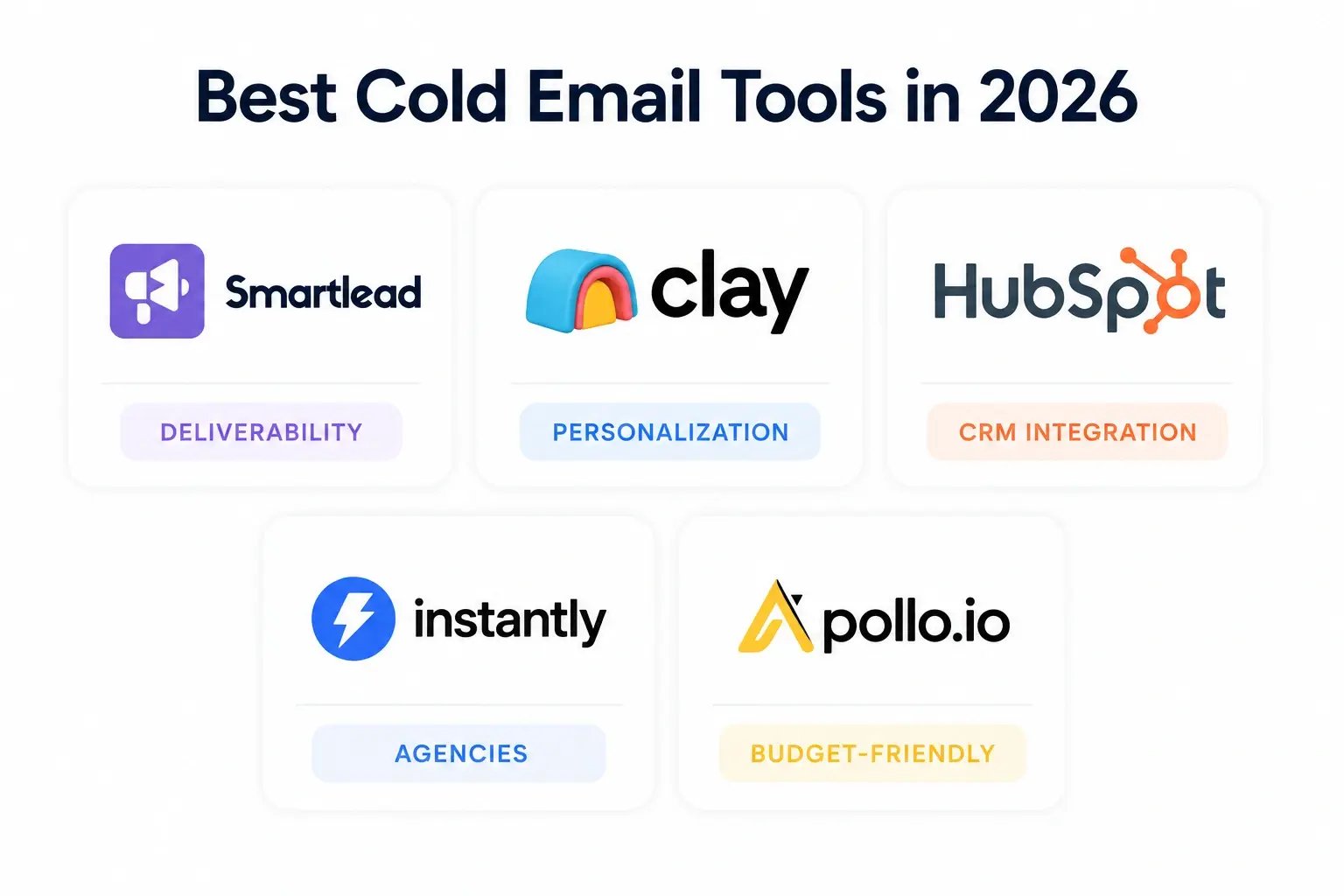 The cold email software market is crowded now, but only a handful of platforms consistently perform well operationally.
Best for Deliverability
Smartlead has become one of the strongest platforms for inbox rotation, domain management, and deliverability-focused outbound campaigns.
Best for Personalization & Enrichment
Clay stands out for signal-based personalization, enrichment, and workflow automation.
Best CRM Integration
HubSpot remains one of the best systems for connecting outbound activity directly to pipeline management, automation, and customer data.
Best for Agencies
Instantly is widely used by agencies because it simplifies large-scale outbound infrastructure and campaign management.
Best Budget-Friendly Option
Apollo.io offers a strong combination of prospecting data, sequencing, and outreach functionality for smaller teams and startups.
The best tool depends less on features and more on how well it fits your outbound workflow and operational maturity.
Metrics That Actually Matter
Many outbound teams track vanity metrics instead of indicators that truly reflect campaign health and pipeline quality.
Here are the metrics that matter most in 2026.
Positive Reply Rate
Positive reply rate is one of the strongest indicators of messaging relevance and targeting quality.
A lower-volume campaign with strong positive replies is usually far more valuable than massive outreach with weak engagement.
Bounce Rate
High bounce rates usually indicate poor list quality or weak data verification processes.
Consistently high bounce rates damage domain reputation and inbox placement over time.
Domain Health
Cold email success depends heavily on sender reputation and infrastructure quality.
Healthy domains generally maintain:
- consistent sending behavior
- low spam complaints
- strong inbox placement
- positive engagement signals
Open Rate (Why It’s Less Reliable Now)
Open rate tracking has become less accurate due to privacy updates and email client changes.
It can still provide directional insights, but reply quality matters far more than inflated open-rate numbers.
Meetings Booked
Ultimately, outbound campaigns should create conversations and pipeline opportunities.
Meetings booked remain one of the clearest indicators of outbound effectiveness.
Pipeline Generated
The real goal of cold outreach is revenue impact, not email activity.
Strong outbound systems connect campaign performance directly to pipeline generation and closed business instead of vanity engagement metrics.
Final Verdict: What Actually Wins in Cold Email Today
Cold email still works extremely well in 2026, but the rules changed.
The companies succeeding today are not necessarily sending the highest volume. They are building better systems.
Modern cold outreach is now a combination of:
- strong deliverability infrastructure
- precise targeting
- contextual relevance
- conversational messaging
- operational consistency
The biggest shift is that trust matters more than automation.
Buyers are overwhelmed with generic AI-generated outreach. That means relevance, timing, and authenticity now create a competitive advantage.
The best cold emails do not feel like campaigns. They feel like thoughtful business conversations sent at the right moment.
And in most cases, quality still beats scale.
FAQs
Is cold email still effective in 2026?
Yes. Cold email still performs extremely well when targeting, deliverability, and messaging are handled correctly. Most failures come from poor execution, not the channel itself.
What’s a good cold email reply rate?
This varies by industry and targeting quality, but many strong B2B campaigns aim for positive reply rates between 5% and 15%.
How many cold emails should I send per day?
Most modern outbound teams prioritize controlled sending volume instead of aggressive scaling. Daily volume depends heavily on infrastructure quality and domain reputation.
Are AI-written cold emails effective?
AI can help with research, segmentation, and workflow efficiency. Fully AI-generated outreach usually performs poorly without human editing and contextual relevance.
What’s the ideal cold email length?
Most successful cold emails stay under 120 words. Shorter emails generally create less friction and higher response rates.
How many follow-ups should I send?
Many outbound teams use between 3 to 6 follow-ups depending on campaign type and prospect quality. The key is staying relevant without becoming repetitive or aggressive.
Is cold emailing legal?
Cold emailing is legal in many regions when businesses follow local compliance regulations such as CAN-SPAM, GDPR, and proper unsubscribe practices.
What tools are best for cold outreach?
Popular outbound tools in 2026 include Smartlead, Clay, Instantly, Apollo.io, and HubSpot depending on workflow needs.
Founder & CEO @ Hubxpert. My goal is to make every company using HubSpot succeed in their marketing organisation and automation.

Ratul Rahman
Table of Contents:

Subscribe to our newsletter
HubSpot Agency Partner Program Reseller White Label Routes
See how the HubSpot agency partner program, reseller and white label routes differ, then set up a white-labeled partner portal that clients actually use.

Do You Need a Healthcare-Specific CRM, or HubSpot?
Some practices outgrow HubSpot. Most don't. Here is the real threshold test, and where a healthcare-specific CRM actually wins.
Referral Tracking Software or Your CRM? A Healthcare Guide
HubSpot has no native referral object. Here is how referral tracking actually gets built inside a CRM, and when you need dedicated software instead.
HubSpot at Enterprise Scale: Fix Pipeline Velocity First
Slow pipeline velocity often gets blamed on HubSpot outgrowing enterprise needs. Here's how to diagnose the real cause before a costly Salesforce migration.
Syncing Invoices Between HubSpot & Your Accounting Software
A healthcare CRM tracks inquiries as records, moves them through a visible pipeline, and automates the follow-up. Here is how.

CRM for Healthcare: How It Actually Works Day to Day
A healthcare CRM tracks inquiries as records, moves them through a visible pipeline, and automates the follow-up. Here is how.
-
HubSpot Agency Partner Program Reseller White Label Routes
hello
-
Do You Need a Healthcare-Specific CRM, or HubSpot?
hello
-
Referral Tracking Software or Your CRM? A Healthcare Guide
hello
-
HubSpot at Enterprise Scale: Fix Pipeline Velocity First
hello
-
Syncing Invoices Between HubSpot & Your Accounting Software
hello
-
CRM for Healthcare: How It Actually Works Day to Day
hello