




-2.png)

-2.png)


.png)


.webp)

.png)


.png)










-1.webp)
-1.webp)

.webp)
-1-1.webp)


-2.webp)

-1-1.webp)

-2-1.png)

-1-1.webp)
-1-1.webp)
-1-1.png)





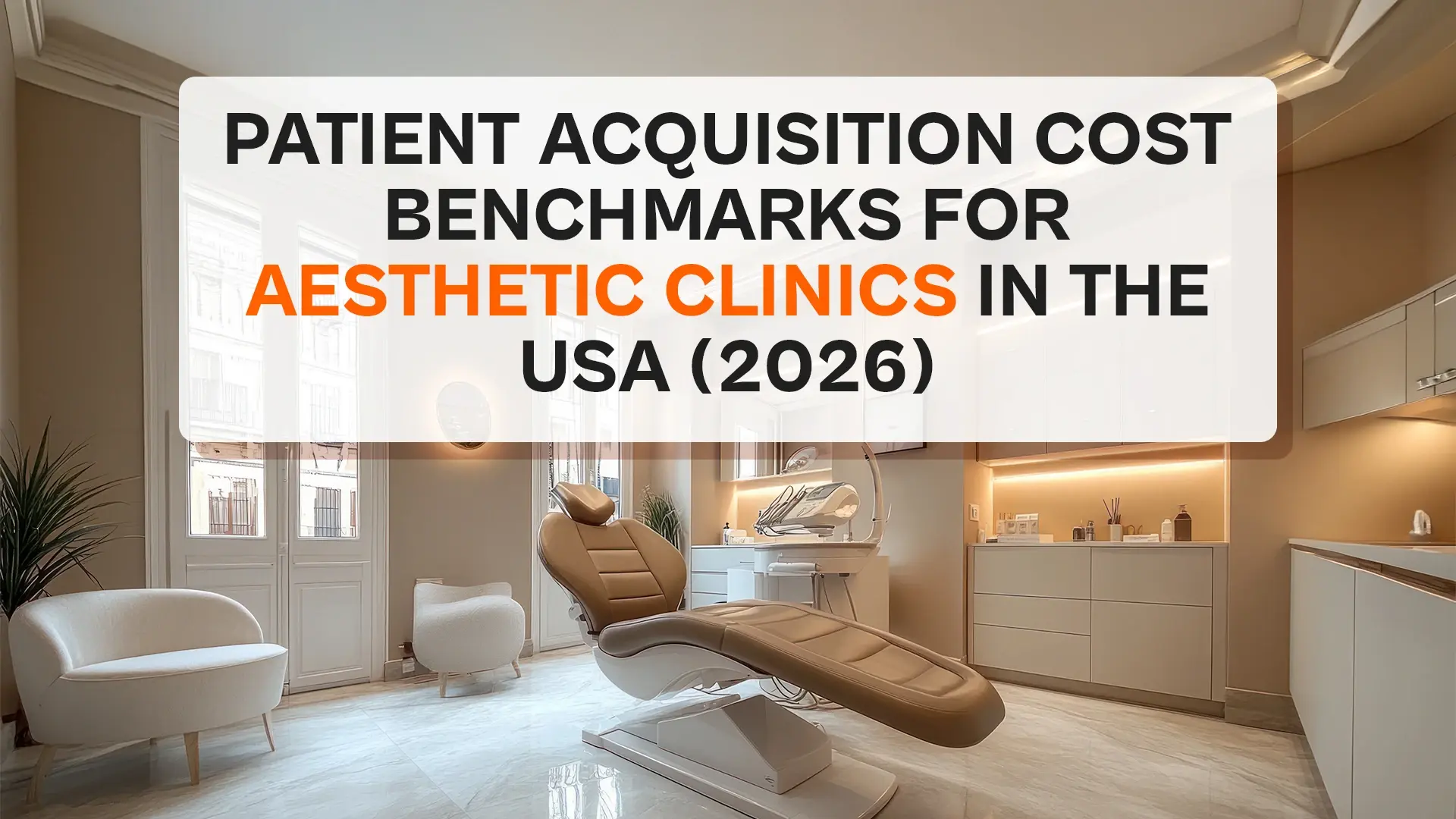
Every aesthetic clinic owner I've ever asked the same question, 'What's your patient acquisition cost?', answers in one of two ways. Either they guess ('Maybe $300?'), or they say they don't track it. Almost no one has a real, attributed number.
That matters more than it sounds. North America captured 42% of global aesthetic revenue in 2025 (Mordor Intelligence, 2026) and U.S. clinics are competing for that share with ad costs that have risen 30–50% over the past four years. Without a real CAC number, you can't price treatments correctly, you can't tell which channel is profitable, and you can't scale paid acquisition with confidence.
This guide walks through 2026 CAC benchmarks for U.S. aesthetic clinics, how most clinics calculate it wrong, and how to track it accurately inside HubSpot.
What CAC actually means for aesthetic clinics
Patient acquisition cost is the all-in cost to acquire one new, paying patient. Not a lead. Not a consultation. A patient who actually pays for a procedure.
Most clinics use 'marketing spend ÷ leads', which is cost per lead, not CAC. The gap between the two is usually five to fifteen times, and ignoring that gap is the single biggest reason clinics overspend on ads.
%201%20(1).svg)
The formula:
CAC = (Total marketing spend + sales/coordinator labor + tech stack costs) ÷ Number of new paying patients acquired in the same period.
2026 CAC benchmarks by procedure type
Injectables (Botox, Dysport, fillers)
- First-time patient CAC: $80–$200
- Repeat patient acquisition (reactivation): $15–$45
- Healthy CAC-to-AOV ratio: 1:3 or better (treatment AOV $450–$700)
Non-surgical body contouring and lasers
- First-time patient CAC: $180–$420
- Treatment AOV: $1,200–$3,500
- Healthy CAC-to-AOV ratio: 1:6 or better
Surgical procedures (rhinoplasty, breast augmentation, liposuction, etc.)
- First-time patient CAC: $400–$1,200
- Treatment AOV: $6,500–$15,000
- Healthy CAC-to-AOV ratio: 1:10 or better
Premium combo procedures (mommy makeover, full-face rejuvenation)
- First-time patient CAC: $900–$2,500
- Treatment AOV: $18,000–$40,000
- Healthy CAC-to-AOV ratio: 1:15 or better
Clinics tracking CAC properly typically run 30–40% lower than these benchmarks; clinics guessing typically run 30–50% higher. That gap is your competitive moat, or your liability.
Channel-specific CAC ranges in 2026
Procedure-tier benchmarks only tell you part of the picture. The real money question is: which channel produces patients at the lowest cost, and how does that change by procedure? Based on our cross-client data over the last 24 months, here's what each channel typically costs to acquire a paying patient:
- Google Search ads: $120–$280 for injectables, $400–$900 for surgical. High-intent, fastest payback, the channel to scale first.
- Meta (Facebook + Instagram) ads: $80–$220 for injectables, $500–$1,400 for surgical. Lower CPL than Google, but conversion-to-patient is roughly half, so net CAC ends up similar or higher.
- TikTok ads: $60–$160 for injectables, but heavily skewed under-30 demographic. Strong for body-contouring and entry injectables; weak for surgical.
- Organic SEO: $40–$120 for injectables, $150–$400 for surgical. Slowest to spin up (six-to-twelve month lead time), but cheapest long-term CAC by 3–5x.
- Referral programs: $40–$120 across all procedures. Highest-LTV channel, but caps out around 20–25% of new patients no matter how well you run it.
- RealSelf and aesthetic-specific directories: $200–$450 for surgical, less relevant for injectables. Useful but rarely top three.
If you can run Google and SEO with discipline, you cover 60–70% of acquisition at sustainable CAC. Most clinics over-rely on Meta because the CPL number is flattering, but CPL isn't CAC.
How most clinics calculate CAC wrong
Mistake #1: Counting cost per lead instead of cost per patient
If your ads generate 100 leads at $50 each and 6 of them book a procedure, your CAC isn't $50. It's $833. Most clinics quote the $50 number because that's what the ad platform shows them.
Mistake #2: Ignoring labor costs
Your consultation coordinator's salary is part of CAC. So is the front-desk staff time spent following up. For a clinic where each booked patient requires roughly 1.5 hours of coordinator time at $35/hour, that's $52.50 of hidden CAC per patient, almost never counted.
Mistake #3: Counting referrals at zero cost
Referrals aren't free. The referring patient often gets a credit. Your team spends time enrolling them. Track this: typical referral CAC is $40–$120, which is still excellent but isn't zero.
Mistake #4: Averaging across all channels
A 'blended CAC of $250' hides the fact that Facebook ads might be running at $400 and organic SEO at $80. Always track CAC per channel. That's where you find the channels worth doubling down on.
Using HubSpot to track CAC accurately
HubSpot makes attributed CAC tracking possible for any aesthetic clinic willing to set up the right plumbing. The build:
- Connect your ad accounts. Facebook, Instagram, Google Ads, and TikTok are all native integrations.
- Use UTM-tagged links on every campaign. Without UTMs, HubSpot can't tell which lead came from which ad.
- Set up first-touch and last-touch attribution. Or, on Marketing Hub Enterprise, multi-touch attribution. Most clinics start with last-touch and graduate.
- Connect revenue source via booking-software integration. So HubSpot knows when a lead becomes a paying patient and at what value.
- Build a CAC-by-channel dashboard. Refresh weekly. Reallocate ad spend monthly based on what it shows.
CAC Is Meaningless Without LTV: The Ratio That Actually Matters
A $400 CAC on injectables sounds bad. Until you realize an active injectable patient is worth $4,800 over three years. That's a 12:1 LTV-to-CAC ratio, exceptional by any industry standard.
Healthy 3-year LTV-to-CAC benchmarks for U.S. aesthetic clinics tracking both numbers properly:
- Injectables: 8:1 to 14:1. Most patients return two to three times per year for three or more years.
- Lasers and body contouring: 4:1 to 8:1. Multi-session packages drive most of the LTV.
- Surgical procedures: 10:1 to 18:1. High AOV per procedure plus typical 1.4 procedures per patient over five years.
If your LTV-to-CAC ratio is below 3:1 on any channel, that channel is unprofitable once you account for true labor and tech costs. Above 6:1, you should be doubling spend if your operations can handle the volume.
A real misattribution example
A multi-location med spa we audited last year was spending $35,000 a month on paid social and reporting a 'CAC of $180' based on Meta Ads Manager. They were considering doubling spend on Facebook.
When we connected HubSpot to their booking software and ran true last-touch attribution for 60 days, the real numbers were very different: Facebook CAC was $620, Google Ads CAC was $210, and organic SEO CAC was $95. The $180 number had been counting form fills as 'patients.'
We didn't reduce their total ad spend. We reallocated it: 60% out of Facebook, 30% into Google, 30% into SEO content production. Three months later, they were acquiring 40% more patients on the same budget. The fix wasn't more money. It was honest numbers.
CAC Red Flags: Signs Your Tracking Is Broken
If any of these are true for your clinic, your CAC number is probably fiction:
- You quote 'CAC' from inside Meta Ads Manager or Google Ads. Both platforms show cost per lead at best, not cost per paying patient. The gap is usually 5–15x.
- Your CAC has been the same number for six months. Real CAC fluctuates 15–30% quarter to quarter as ad costs, seasonality, and conversion rates shift. A static number means you're not measuring.
- Your CAC across all channels is identical. Facebook, Google, and SEO don't produce patients at the same cost. They never have. Blended numbers hide the channels you should defund.
- You haven't reallocated ad budget in the last 90 days. If the data isn't changing your decisions, the data is decorative.
Your finance team and marketing team quote different CAC numbers. Almost guaranteed sign that one or both is wrong. Pick one source of truth (HubSpot, if you can) and run from there.
What CAC tracking changes about how you run the clinic
Once you can see CAC by channel and procedure type, three things change in how the business is run. Ad budget conversations stop being political. They become arithmetic. The channel with the best CAC-to-LTV ratio gets more budget, period.
Second, you stop discounting reflexively. When you know that a $300 CAC patient is worth $4,800 over three years, offering a $50 first-visit credit feels obvious instead of risky. Most clinics under-invest in acquisition because they don't trust their own math.
Third, you start thinking about LTV expansion as seriously as CAC reduction. A patient on a Botox membership is worth two to three times a patient on ad-hoc visits, and the cost of getting them to upgrade is nearly zero. CAC reduction has a floor. LTV expansion doesn't.
How HubXpert helps aesthetic clinics win
We've spent 5+ years and 150+ projects helping service businesses get real revenue out of HubSpot. For aesthetic clinics specifically, we know the operational rhythm: high-ticket consultations, long consideration windows, repeat injectable cycles, and patients who research for four to six weeks before walking in.
We build CAC-tracking dashboards for aesthetic clinics that show, in one screen, exact cost per patient by channel and by procedure type. Clinics typically reallocate 20–30% of their ad spend within the first 90 days based on what the dashboard surfaces.
We can plug into your existing stack through our HubSpot integration practice (booking software, EHR, payment processor), so HubSpot becomes the single source of truth for your front desk, your marketers, and your surgeons, not another tool fighting for attention.
For a real-world example of what end-to-end HubSpot looks like in practice, see our patient lifecycle transformation case study with Leva Medical, a healthcare provider where we rebuilt the full HubSpot journey from acquisition through retention.
Founder & CEO @ Hubxpert. My goal is to make every company using HubSpot succeed in their marketing organisation and automation.

Ratul Rahman
Table of Contents:

Subscribe to our newsletter
HubSpot Agency Partner Program Reseller White Label Routes
See how the HubSpot agency partner program, reseller and white label routes differ, then set up a white-labeled partner portal that clients actually use.
Do You Need a Healthcare-Specific CRM, or HubSpot?
Some practices outgrow HubSpot. Most don't. Here is the real threshold test, and where a healthcare-specific CRM actually wins.
Referral Tracking Software or Your CRM? A Healthcare Guide
HubSpot has no native referral object. Here is how referral tracking actually gets built inside a CRM, and when you need dedicated software instead.

HubSpot at Enterprise Scale: Fix Pipeline Velocity First
Slow pipeline velocity often gets blamed on HubSpot outgrowing enterprise needs. Here's how to diagnose the real cause before a costly Salesforce migration.
Syncing Invoices Between HubSpot & Your Accounting Software
A healthcare CRM tracks inquiries as records, moves them through a visible pipeline, and automates the follow-up. Here is how.
CRM for Healthcare: How It Actually Works Day to Day
A healthcare CRM tracks inquiries as records, moves them through a visible pipeline, and automates the follow-up. Here is how.
-
HubSpot Agency Partner Program Reseller White Label Routes
hello
-
Do You Need a Healthcare-Specific CRM, or HubSpot?
hello
-
Referral Tracking Software or Your CRM? A Healthcare Guide
hello
-
HubSpot at Enterprise Scale: Fix Pipeline Velocity First
hello
-
Syncing Invoices Between HubSpot & Your Accounting Software
hello
-
CRM for Healthcare: How It Actually Works Day to Day
hello