-2.png)
-2.png)
.png)
.webp)
.png)
.png)




-1.webp)
-1.webp)

.webp)
-1-1.webp)
-2.webp)
-1-1.webp)
-2-1.png)
-1-1.webp)
-1-1.webp)
-1-1.png)


HubSpot vs Zoho CRM:
A Comprehensive Comparison for 2025
In today’s fast-paced business world, a Customer Relationship Management (CRM) system is more than just a tool—it’s a strategic partner that helps you organise customer interactions, streamline sales, and fuel growth.
Why Compare HubSpot and Zoho CRM?
Choosing the right CRM is a critical decision. A well-suited CRM can boost your team’s productivity, improve customer relationships, and drive revenue, while a poor fit can lead to frustration and wasted resources. HubSpot and Zoho are both industry leaders, but they approach CRM differently. HubSpot is celebrated for its user-friendly, all-in-one platform, particularly for marketing-driven businesses. Zoho, on the other hand, offers a cost-effective, highly customizable solution tailored for sales-focused teams. This blog will break down their differences to guide you toward the right choice.
.webp)
-1.webp "Comparison Table (630 x 1200 px)-1")
Overview of
HubSpot
Founded in 2006, HubSpot is a pioneer in inbound marketing, offering a suite of tools for marketing, sales, customer service, and content management, with a free CRM at its core. Serving over 100,000 customers worldwide, HubSpot is designed to help businesses attract, engage, and delight customers.
-
Key Features of HubSpot
- Free CRM: Manage up to 1 million records with basic contact and deal management.
- Marketing Hub: Tools for SEO, social media, email marketing, and content management.
- Sales Hub: Sales automation, email tracking, meeting scheduling, and deal insights.
- Service Hub: Ticketing, knowledge base, and customer feedback tools.
- Operations Hub: Data sync, workflow automation, and integrations.
- CMS Hub: Website building and content creation.
Overview of
Zoho CRM
Zoho CRM is part of the Zoho ecosystem, a suite of cloud-based business applications. With over 20 years in the industry, Zoho serves businesses of all sizes, offering a flexible CRM that excels in sales automation and integrations.
-
Key Features of Zoho CRM
- Sales Automation: Lead management, pipeline tracking, and deal management.
- Marketing Automation: Email campaigns, social media, and lead nurturing.
- Customer Support: Ticketing and self-service portals.
- Analytics: Dashboards, 40+ reports, and custom reporting.
- Mobile Apps: iOS and Android support.
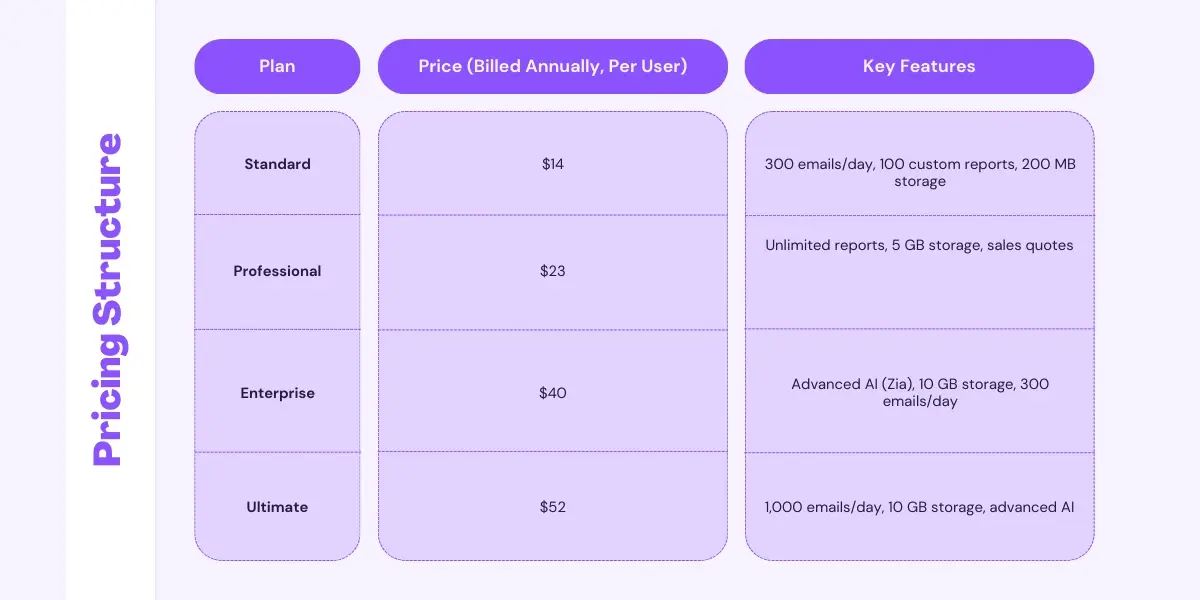
Pricing
Comparison
-
HubSpot
HubSpot’s pricing starts at $15/month for the entire account, making it appealing for small teams. However, costs can climb quickly with additional users or hubs, and higher tiers like Professional ($90/month) or Enterprise ($150/month) are significantly pricier.
-
Zoho
Zoho’s per-user pricing, starting at $14/user/month, is more predictable for larger teams, with even the top-tier Ultimate plan at $52/user/month being more affordable than HubSpot’s mid-tier plans.
Winner
Zoho is generally more budget-friendly, especially for teams with many users. HubSpot’s pricing suits smaller teams or those needing integrated hubs.
Features
Comparison
-
HubSpot
- Excels in marketing automation with tools for SEO, social media, and email campaigns. Its Sales Hub includes advanced features like lead scoring and deal insights.
- Offers shared dashboards, sales forecasting, and attribution reports. Free plans include 3 dashboards with 10 reports each; paid plans scale to 50 dashboards with 30 reports.
- Strong in marketing workflows and general automation, with custom workflows for ticketing and pre/post-sale processes.
- Includes email, social media, VoIP, and power dialer.
- Over 1,700 integrations, including Shopify, WooCommerce, and Square, with a robust API.
-
Zoho
- Strong in sales automation, offering lead management, pipeline tracking, and data enrichment. Its marketing tools are solid but less comprehensive than HubSpot’s.
- Provides 40+ reports and precise analytics. Standard plans offer 100 custom reports, with unlimited reports on higher tiers.
- Offers extensive sales and marketing automations, with highly customisable workflows that may suit complex processes better.
- Matches HubSpot’s offerings and adds WhatsApp and SMS, ideal for diverse communication needs.
- Over 2,000 integrations, including Zoho Commerce and Shopify via Zapier, plus extensive custom apps.
Winner
HubSpot is better for marketing-driven businesses, while Zoho excels in sales automation and customisation.
Ease of Use and User Interface
Comparison
-
HubSpot
HubSpot’s interface is sleek and intuitive, often described as “Apple-like” for its simplicity. It’s ideal for teams with minimal technical expertise.
-
Zoho
Zoho’s interface, while functional, can feel clunky due to its modular structure, requiring more time to navigate between apps.
Winner
HubSpot takes the lead for ease of use, especially for non-technical users.
Customer Support
Comparison
-
HubSpot
HubSpot offers multiple support channels, including email, phone, chat, and a comprehensive knowledge base, with near-instant response times.
-
Zoho
Zoho provides solid support via chat and ticketing, but some users note language barriers with its India-based team, though it’s generally responsive.
Winner
HubSpot has a slight edge due to its broader support options and faster responses.
Scalability
Comparison
Beyond the base pricing, there are several additional costs to consider:
-
HubSpot
HubSpot is built to scale, supporting small businesses to large enterprises with its tiered pricing and additional hubs.
-
Zoho
Zoho is scalable but may face limitations in customization, API calls, or integrations as businesses grow, requiring technical workarounds.
Winner
HubSpot is more scalable for long-term growth.
Use Case
Scenarios
To better understand which CRM suits your needs, let’s explore some practical scenarios where HubSpot or Zoho CRM might be the better choice
-
Scenario 1: A Growing E-Commerce Business
Imagine you run a mid-sized e-commerce store with a team of 10, focusing on both sales and marketing. You need a CRM to manage leads, run email campaigns, and track customer interactions across social media. HubSpot is likely the better choice here. Its Marketing Hub offers advanced tools for email campaigns and social media management, and the seamless integration between its sales and marketing tools ensures your team can work efficiently. While the cost might be higher (e.g., $90/month for the Professional plan), the investment pays off with its scalability and ease of use as your business grows.
-
Scenario 2: A Small Sales-Driven Startup
You’re a startup with a lean team of 5, focused on closing deals and managing a tight budget. Your priority is sales automation, and you don’t need extensive marketing tools yet. Zoho CRM fits perfectly here. Starting at $14/user/month, it’s cost-effective for your small team, and its sales automation features—like lead management and pipeline tracking—help you stay organised. The free plan for up to 3 users is also a great way to test the platform before committing.
-
Scenario 3: A Consulting Firm with Complex Workflows
If you’re a consulting firm with 20 employees and complex sales processes, you might need a CRM that can handle custom workflows and integrations with tools like email and project management software. HubSpot stands out in this scenario. Its highly customisable workflows allow you to tailor the platform to your specific needs, and with over 1,700 integrations, you can connect it to your existing tools. While the interface might take some time, the flexibility makes it worth the effort.
Key Takeaway
HubSpot is ideal for businesses needing integrated marketing and sales tools, while Zoho is better for sales-focused teams with specific customisation needs.
Conclusion: HubSpot or Zoho?
Choose HubSpot if you’re a growing business that values ease of use, integrated marketing tools, and scalability. It’s ideal for mid-sized or marketing-driven teams willing to invest in a premium platform.
Choose Zoho if you’re budget-conscious, need strong sales automation, and are comfortable with some technical setup. It’s perfect for small businesses or startups looking for flexibility.

5+
Years of Industry Experience
150+
Projects Completed
98%
Positive Reviews
40+
Trusted Partners

Hubxpert's Role as a Platinum Partner
Looking to get HubSpot at the best possible price? As a HubSpot Platinum Partner, Hubxpert can offer exclusive discounts on HubSpot’s base pricing—helping you save while scaling smarter. Plus, we don’t just set you up; we train your team to ensure you get the most out of HubSpot’s powerful tools. From onboarding to optimisation, we make HubSpot easier, more affordable, and more effective for your business!